Saturday, December 30, 2023

My Bourbon Writing Will Not be Rationed


An anti-hoarding, pro-rationing poster for the United States during World War II.

The rationing poster above refers to an article in the new issue of The Bourbon Country Reader, which subscribers will receive shortly, but I wanted to start with a thank you.

The response to my December 13 post was more than I could have asked for, and very much appreciated. Thank you to everyone who commented. As I wrote after the first dozen or so comments came in, my short post happened because lately I feel I am shouting into the void. As a speech major in college, I was taught basic communication theory. The parts of communication are sender, message, receiver, and feedback. The feedback informs the sender as to how the message was received, so it can be modified or built upon. It's pretty basic stuff but the key insight is that communication is a loop, a cycle. One may send messages to some expected receiver, but without feedback there is no communication. 

Some of you are subscribers to my old school, paper-in-the-mail newsletter. I wrapped volume 21 back in August and have been dragging my feet on starting volume 22. I have considered discontinuing the newsletter altogether. Thanks to all of you and your encouragement, volume 22, number 1 is at the printer now and will be in the mail in a few days.

You can subscribe here.

What is in the new issue? Exactly 80 years ago, in December 1943, two years after the attack on Pearl Harbor dragged the United States into World War II, a fullpage advertisement appeared in newspapers across the country. The ad’s headline got right to the point: “The TRUTH about the Whiskey Shortage” (emphasis in the original).

Modern "whiskey shortage" concerns are laughable compared to this.

The ad set out to answer three questions: “Is there really a shortage?,” “How much whiskey is available?,” and “How long will the present supply last?”

You will find the whole story in the new Reader.

What else? About a decade ago, I began to keep track of all the column stills making whiskey in the United States. Why? Because the size (i.e., diameter) of a column still tells you that distillery's production capacity, not how much it will produce, or does produce, but how much it can produce. In the story "Size Matters," I go into some of what I've learned from that project. 

Launched in 1994, The Bourbon Country Reader is the oldest publication devoted entirely to American whiskey. It is an eclectic mix of news, history, analysis, and product reviews. Do you worry that advertising influences coverage in other publications? No chance of that here since The Bourbon Country Reader is 100 percent reader-supported. It accepts no advertising. 

To experience The Bourbon Country Reader for yourself, you need to subscribe. Honoring history, The Bourbon Country Reader is still exclusively on paper, sent in an envelope via the USPS. 

Despite rampant inflation, a subscription to The Bourbon Country Reader is a mere $25 per year for addresses in the USA, $32 USD for everyone else. The Bourbon Country Reader is published six times a year, more-or-less, but your subscription always includes six issues no matter how long it takes. For those of you keeping track, this new one is Volume 22, Number 1. 


If you prefer to pay by check, make it payable to Made and Bottled in Kentucky, and mail it to Made and Bottled in Kentucky, 3712 N. Broadway, PMB 298, Chicago, IL 60613-4198. Checks drawn on U.S. banks only, please.


Wednesday, December 13, 2023

Now Is the Time to Tell Me

I haven't posted much recently. If you miss it, now is the time to tell me. 

Monday, September 25, 2023

This Is ... Interesting


The "updated" Kentucky Bourbon Hall of Fame® award.
I was inducted into the Kentucky Bourbon Hall of Fame (KBHOF) in 2009. It's a nice honor. It came with a replica copper still, with my name on it, and a personalised lapel pin. That's pretty much it. There is no actual, physical hall. A list of all members, not yet updated for 2023, is here

For all intents and purposes, those two pages are the Kentucky Bourbon Hall of Fame.

Current, living members of the KBHOF have no role in the selection of prospective members or, well, anything. The KBHOF is run by the Kentucky Distillers Association (KDA), which apparently also owns the registered trademark for it. The only on-going perk of membership was the annual induction luncheon during the Kentucky Bourbon Festival, but now hall members are expected to buy tickets for that like everyone else. The invitation included a free glass. At least, I think it was free.

Then this arrived today:

"Greetings Kentucky Bourbon Hall of Fame® Members - 

"As you may be aware, in 2022 the Hall of Fame Selection Committee and Kentucky Distillers’ Association [KDA] took the initiative to update the Kentucky Bourbon Hall of Fame® award. The KDA commissioned glassblowing artist Brook Forrest White, Jr. of Flame Run in Louisville to design and craft a unique and contemporary award that incorporates Bourbon-inspired motifs such as amber colors, oak, Copper and water. The limestone award based has been crafted by JoEl E. Ford, owner of Kentucky Cut Stone, located in Lancaster, to symbolize the natural-cut limestone so valuable to the Bourbon industry. The award rounds-out with a Copper name plate that includes the recipient’s name, industry award and Kentucky Bourbon Hall of Fame® logo. For your reference, see image below/attached.

"The KDA has been reached by several Hall of Fame members requesting the opportunity to purchase this new award style. 

"If you are interested in ordering a new Kentucky Bourbon Hall of Fame® award, reach (NAME AND EMAIL ADDRESS REDACTED). Please note you will be invoiced for $1,000 to cover the cost of the award. You will be notified when your award is ready and available for pick-up at Kentucky Distillers’ Association headquarters in Frankfort, KY – we are unable to ship the awards. Orders will be accepted until, Friday, October 6th. Production will take approximately 6 weeks."

Kentucky Bourbon Hall of Fame Class of
2009, with the original awards.
I redacted the name of the contact person at KDA, who can hardly be blamed for this, but who perhaps bears responsibility for the grammatical lapses and weird capitalization in the email. 

I have been persona non grata with the KDA for about a decade, ever since I posted this and this, and probably a few other things. All constructive criticism, of course.

Needless to say, my check for $1,000 is not in the mail.

Thursday, August 31, 2023

New Still Will Increase Heaven Hill's Capacity by One-Third, on Way to Doubling It


Heaven Hill installs the column still at its new distillery in Bardstown.
Heaven Hill today, with much fanfare, installed the column still that will be the centerpiece of their new Bardstown distillery. It's a big one, five-and-a-half feet in diameter. They say it is capable of producing 35,500 proof-gallons per day, which is equal to more than 500 barrels per day. 

Heaven Hill is one of the four companies who together make about 70 percent of America's whiskey. Even as many new whiskey companies have come online, the Big Four have all gotten bigger. 

This milestone is exciting because it marks Heaven Hill's return to Bardstown as a distiller. They are also restoring an old name, Heaven Hill Springs, for this facility.

Since 1996, when fire destroyed Heaven Hill's original Bardstown distillery, Heaven Hill has made its whiskey at its Bernheim Distillery in Louisville, where it has three column stills slightly smaller than this one. When they put the last 60" still in at Bernheim, they said that was it. They couldn't add more capacity to that facility. They say that facility's current capacity is 450,000 barrels per year and the new facility is planned to reach that same capacity in time, which means they must already have holes in the floor for two additional stills. 

They had to do this because they were all out of room at Bernheim. There is plenty in Bardstown. The new distillery is being built on a surprisingly empty piece of land between Old Bloomfield Pike and New Bloomfield Road, aka US-62. It's just west of where the old Fairfield Distillery was, where Heaven Hill has maturation warehouses today.

Nothing in Bardstown is very far from anything else and Heaven Hill has several facilities in the area. The main campus is south of downtown, on Loretto Road, by Willett and on the way to Maker's Mark.

All the gang was there. Vendome made the still and Buzick did the installation. Heaven Hill executives and other dignitaries watched from a respectful distance.


Monday, August 14, 2023

New 'Reader,' Out Now, Explores Mexican Bourbon and Whiskey QC


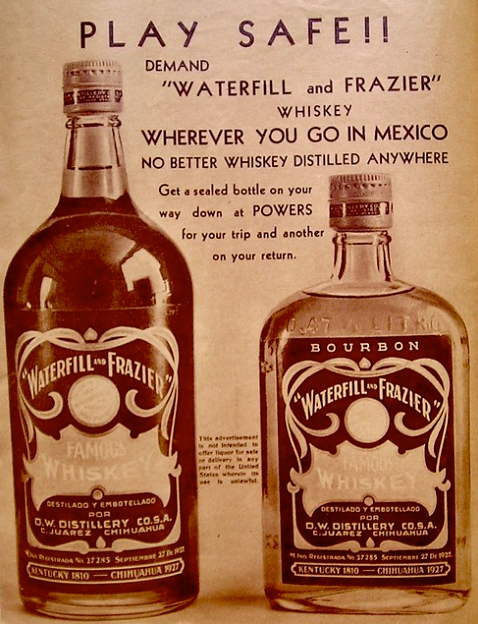
Ad for Mary Dowling's Made-in-Mexico Bourbon
Earlier this summer, Kaveh Zamanian and Pernod-Ricard announced the formation of the Mary Dowling Whiskey Company, a new brand. The whiskey is from Rabbit Hole, but they're not talking about that so much as they are about Mary Dowling, and what a story it is.

You can read all about it in the latest issue of The Bourbon Country Reader, available now!

Zamanian and Pernod have dubbed Mary Dowling the “Mother of Bourbon.” Whether or not she was the mother of anything other than her nine children, Mary Dowling’s story is remarkable. If you must pluck a name from history to adorn a new whiskey brand, she is a good choice. If any historical figure represents the internationalization of American whiskey, it is her.

The apogee of her story was her extreme attempt to stay in business during Prohibition by moving her entire distillery 1,500 miles southwest, to Juarez, Mexico. Although it is another 1,000 miles from Juarez to Jalisco, where tequila is made, Mary Dowling Tequila Barrel is a high rye, double malt, Kentucky straight bourbon. Four years old, it is finished in American oak previously used to age Tequila and bottled at 90° proof (45% ABV).

That's pretty much what Zamanian and Pernod will tell you, but there is much more to Mary Dowling's story and The Reader has it all.

Also in this issue, we take a deep dive into the subject of whiskey consistency. Today, while a new breed of whiskey enthusiast primarily buys limited editions, most whiskey is sold to brand loyalists who expect their favorite to always taste exactly the same. Achieving that consistency is not as easy as you might think. We break it down in the new Reader.

Launched in 1994, The Bourbon Country Reader is the oldest publication devoted entirely to American whiskey. It is an eclectic mix of news, history, analysis, and product reviews. Do you worry that advertising spending influences coverage in other publications? No chance of that here since The Bourbon Country Reader is 100 percent reader-supported. It accepts no advertising.

To experience The Bourbon Country Reader for yourself, you need to subscribe. Honoring history, The Bourbon Country Reader is still exclusively on paper, sent in an envelope via the USPS. Doing our part to keep them solvent, we use only First Class Mail.

Nevertheless, a subscription to The Bourbon Country Reader is a mere $25 per year for addresses in the USA, $32 USD for everyone else. The Bourbon Country Reader is published six times a year, more-or-less, but your subscription always includes six issues no matter how long it takes. For those of you keeping track, this new one is Volume 21, Number 6. 


If you prefer to pay by check, make it payable to Made and Bottled in Kentucky, and mail it to Made and Bottled in Kentucky, 3712 N. Broadway, PMB 298, Chicago, IL 60613-4198. Checks drawn on U.S. banks only, please.

Tuesday, August 8, 2023

Will Blue Run's Magnificent Distillery Ever Be Built?


An architect's rendering of Blue Run's proposed
$51 million distillery in Georgetown, Kentucky.

Beermaker Molson Coors announced today it is purchasing Blue Run Spirits. Terms were not disclosed. The deal was reported in the Lexington Herald-Leader.

Despite the usually-reliable Janet Patton calling them one, Blue Run is not a "distillery." Blue Run is a non-distiller producer. The rendering above is just that, an architect's illustration for a proposed distillery in Georgetown, Kentucky. This "preliminary design," released in March with much fanfare, is by the Bjarke Ingels Group, designers of Google's headquarters and the Lego museum.

Will it ever be built? The record is not good. 

In 2017, Stoli Group announced its acquisition of Kentucky Owl, a small, luxury bourbon brand. Later that year Stoli said it would build a $150 million distillery in Bardstown, Kentucky. Land was acquired and some site preparation was done, but the distillery remains unbuilt. Two years ago, they predicted construction would begin in 2024. The Kentucky Owl brand continues to thrive using liquid distilled by Bardstown Bourbon Company and other sources. 

Other examples include Nelson's Green Brier and High West. Although both have distilleries, their acquisitions by major companies were predicated on the success of brands made with sourced liquid. Both companies have house-made products, and High West has transitioned to a blend of sourced and house-made for its top brands. 

The reasoning is simple. If your brand is built on sourced liquid, and a sufficient supply of suitable sourced liquid continues to be available, you have no reason to build a distillery. Sourced brands tend to stay sourced brands until and unless their sources dry up, then they reluctantly become distillers, as happened to Michter's and Luxco. At last report, Blue Run is a 50,000-case brand, and its products are all limited releases. That is part of their appeal. This Forbes article (from 2022) explains what Blue Run is about and what Molson Coors is really buying.

Their first release, the 14-year-old  $169 Kentucky Straight bourbon that made their reputation, was 2,600 bottles. You don't need your own distillery to create releases like that. Their business model has "independent bottler" written all over it.

Jim Rutledge, formerly of Four Roses, is part of the Blue Run team. He is having whiskey contract-distilled for the brand at Castle & Key in Frankfort. 

All of this doesn't mean, of course, that the Blue Run brand might not benefit from a tourism "homeplace," but that doesn't need to be a distillery, doesn't need to be in Georgetown, and doesn't need to cost $51 million.

Friday, August 4, 2023

Heaven Hill Brands and Log Still Distilling LLC Make Statement, Say Nothing


The water tower is a remnant of the distillery that must not be named.

Heaven Hill Brands and Log Still Distilling LLC put out a press release yesterday under the headline, “Heaven Hill Brands and Log Still Distilling LLC Settle Trademark Dispute Over Usage of ‘Dant’ in the Distilled Spirits Industry.” 

It goes on to say Heaven Hill and Log Still are both nice, friendly, family-owned companies in Nelson Country, Kentucky, who have “finalized a mutually agreeable resolution of their dispute regarding the usage of the ‘J.W. Dant’ trademark and its associated goodwill, which were purchased by Heaven Hill in 1993.” Then, after another paragraph about how nice they are and how much they both value intellectual property rights and “strong, independent brand identities within the spirits industry,” they throw in this: “Heaven Hill will continue to be the sole producer of J.W. Dant distilled spirits.”

That’s it. That’s the whole story, at least so far as yesterday's press release is concerned, although it goes on for another 250 words about what nice, friendly companies they both are, how they love their customers, yada yada yada, followed by another 200 words of boilerplate descriptions of the two companies.

So, Heaven Hill owns the J.W. Dant trademark and Log Still can’t use it, end of story. And that pretty much is all there is to it, but that really doesn’t tell you anything, does it?

So I will.

In 2020, Wally Dant, a descendant of J. W. Dant, revived the old distillery site at Gethsemane Station near New Haven as Log Still Distillery, a whiskey resort. The name refers to the legendary wooden still used by his ancestor and made famous via the marketing of J. W. Dant Bourbon over more than a century.

There were many distilleries on the site but the last one before this one was owned by Schenley and made J. W. Dant Bourbon.

When Wally took a Louisville Courier-Journal writer on a tour of Log Still just before it opened, he talked about how in 1836, at age 16, his great-great-great-grandfather fashioned a still from a hollowed-out poplar log. In the interview, he mentioned Cold Spring, the original name of the distillery at Gethsemane Station. He talked about replicating J. W. Dant’s original mash bill. The 1,400-word article mentioned J. W. Dant nine times. 

In 2021, Wally Dant lost a trademark fight with Heaven Hill that restricts his ability to tout Log Still’s connection to the J. W. Dant legacy, although the Log Still name itself survived. He may truthfully tell his family story and stories of the many different distilleries that formally occupied the site, but any use of ‘Dant’ in anything that smacks of branding will bring more trouble. He calls the site ‘Dant Crossing,’ but when he does the following disclaimer must appear: “Log Still Distillery neither owns nor has any affiliation with ‘J.W. Dant’ distilled spirits.” 

Why are they releasing a statement in the summer of 2023 about a dispute decided in 2021? Presumably, the court set some parameters and left the parties to work out the details, which they apparently finished doing earlier this week. The press release doesn't tell you that either, and it doesn't matter, because now we're all friends.

Log Still sells a bourbon called Monk’s Road. The monks at the nearby Abbey of Gethsemani have not objected, yet.