![]() |
| Heaven Hill installs the column still at its new distillery in Bardstown. |
![]() |
| Heaven Hill installs the column still at its new distillery in Bardstown. |
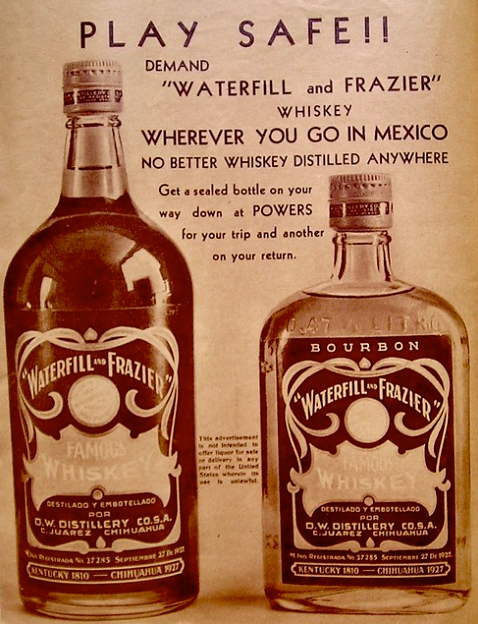
| Ad for Mary Dowling's Made-in-Mexico Bourbon |
You can read all about it in the latest issue of The Bourbon Country Reader, available now!
Zamanian and Pernod have dubbed Mary Dowling the “Mother of Bourbon.” Whether or not she was the mother of anything other than her nine children, Mary Dowling’s story is remarkable. If you must pluck a name from history to adorn a new whiskey brand, she is a good choice. If any historical figure represents the internationalization of American whiskey, it is her.
The apogee of her story was her extreme attempt to stay in business during Prohibition by moving her entire distillery 1,500 miles southwest, to Juarez, Mexico. Although it is another 1,000 miles from Juarez to Jalisco, where tequila is made, Mary Dowling Tequila Barrel is a high rye, double malt, Kentucky straight bourbon. Four years old, it is finished in American oak previously used to age Tequila and bottled at 90° proof (45% ABV).
![]() |
| An architect's rendering of Blue Run's proposed $51 million distillery in Georgetown, Kentucky. |
![]() |
| The water tower is a remnant of the distillery that must not be named. |
Heaven Hill Brands and Log Still Distilling LLC put out a press release yesterday under the headline, “Heaven Hill Brands and Log Still Distilling LLC Settle Trademark Dispute Over Usage of ‘Dant’ in the Distilled Spirits Industry.”
It goes on to say Heaven Hill and Log Still are both nice, friendly, family-owned companies in Nelson Country, Kentucky, who have “finalized a mutually agreeable resolution of their dispute regarding the usage of the ‘J.W. Dant’ trademark and its associated goodwill, which were purchased by Heaven Hill in 1993.” Then, after another paragraph about how nice they are and how much they both value intellectual property rights and “strong, independent brand identities within the spirits industry,” they throw in this: “Heaven Hill will continue to be the sole producer of J.W. Dant distilled spirits.”
That’s it. That’s the whole story, at least so far as yesterday's press release is concerned, although it goes on for another 250 words about what nice, friendly companies they both are, how they love their customers, yada yada yada, followed by another 200 words of boilerplate descriptions of the two companies.
So, Heaven Hill owns the J.W. Dant trademark and Log Still can’t use it, end of story. And that pretty much is all there is to it, but that really doesn’t tell you anything, does it?
So I will.
In 2020, Wally Dant, a descendant of J. W. Dant, revived the old distillery site at Gethsemane Station near New Haven as Log Still Distillery, a whiskey resort. The name refers to the legendary wooden still used by his ancestor and made famous via the marketing of J. W. Dant Bourbon over more than a century.
There were many distilleries on the site but the last one before this one was owned by Schenley and made J. W. Dant Bourbon.
When Wally took a Louisville Courier-Journal writer on a tour of Log Still just before it opened, he talked about how in 1836, at age 16, his great-great-great-grandfather fashioned a still from a hollowed-out poplar log. In the interview, he mentioned Cold Spring, the original name of the distillery at Gethsemane Station. He talked about replicating J. W. Dant’s original mash bill. The 1,400-word article mentioned J. W. Dant nine times.
In 2021, Wally Dant lost a trademark fight with Heaven Hill that restricts his ability to tout Log Still’s connection to the J. W. Dant legacy, although the Log Still name itself survived. He may truthfully tell his family story and stories of the many different distilleries that formally occupied the site, but any use of ‘Dant’ in anything that smacks of branding will bring more trouble. He calls the site ‘Dant Crossing,’ but when he does the following disclaimer must appear: “Log Still Distillery neither owns nor has any affiliation with ‘J.W. Dant’ distilled spirits.”
Why are they releasing a statement in the summer of 2023 about a dispute decided in 2021? Presumably, the court set some parameters and left the parties to work out the details, which they apparently finished doing earlier this week. The press release doesn't tell you that either, and it doesn't matter, because now we're all friends.
Log Still sells a bourbon called Monk’s Road. The monks at the nearby Abbey of Gethsemani have not objected, yet.
![]() |
| The voodoo of Ancestry DNA says some of my people migrated from Maryland to North Central Kentucky in the 18th-19th centuries. |
I have been around the Kentucky bourbon business for about 45 years. I got into it by moving from Ohio to Kentucky for a job. I have been involved in it one way or another ever since.
I didn’t always like the product. My parents drank bourbon. My grandpa drank scotch. I drank beer, then scotch, until I moved to Kentucky where I switched to bourbon.
Living there, I became fascinated with the industry and its culture, and how integral it is to Kentucky’s culture. It was so different from the culture I grew up in, in the adjacent state. I thought that was it, why I was interested, because it is just that interesting. Then I learned it may also be in my blood.
Dad was from St. Louis and mom was from Cleveland, which was just about all I knew about my roots growing up. I became interested in the subject and gradually put flesh on the bones. Mom’s family all came from German-speaking places and landed in Northern Ohio, ultimately Cleveland (West Side). Dad’s family also had Ohio roots, in the southeastern part of the state, along the Ohio River.
That, of course, put them close to Kentucky, so I wasn’t surprised when I learned that my great-grandfather, Homer Cowdery, was born in Kentucky. The family was there for a year or two, then moved back to Ohio. When he got older, Homer took a job on a riverboat and wound up in St. Louis.
Only recently have I learned that the other side of dad's family, my paternal grandmother, Myrtle Gertrude Tucker Cowdery Mansfield, had an even deeper Kentucky connection.
Through Grandma Myrtle I am descended from Joseph 'Short' Tucker, who was part of the mass migration into Kentucky of Catholic religious refugees fleeing Maryland, the same Maryland Catholics who largely founded the Kentucky bourbon industry.
The Tuckers didn’t stay in Nelson County for long. They were part of a smaller group that, after a few years, continued west to Missouri. They kept their faith and their connections to their brethren in Kentucky, however. The same priests who built their church in Bardstown built the Missouri one too.
I don’t know if Short Tucker or any of his descendants made whiskey, but my family’s participation in that Maryland-to-Kentucky migration even shows up in my DNA.
So perhaps I was destined for it after all. I found my roots in a bourbon bottle.
![]() |
| MGPI, Atchison, Kansas. |
If you noticed in the news that MGPI will close its grain neutral spirits distillery in Atchison, Kansas, you may have thought, "Ho hum, one less industrial alcohol distillery. So what?"
The straightforward press release from MGPI soft-pedals the significance of this announcement. It contains all the information investors and other industry participants care about. The news is all there, accurately reported, with all necessary disclaimers, but there is much more to the story.
First, the business angle. MGPI is exiting the business that sustained it for most of its 82 years, the manufacturing of ethanol from corn. It's a different company now, especially since the acquisition of Luxco two-and-a-half years ago. It has other businesses but is now primarily a distilled spirits producer, leading with American whiskey.
Second, the history angle. This distillery in Atchison is where it all began for MGPI in 1941. It is the distillery Cloud Cray bought and expanded to make ethanol for the WWII war industries. He called it Midwest Grain Processors, later abbreviated to MGP. The "I" was added to represent 'ingredients.'
The company's Ingredient Solutions business will continue to operate in Atchison. It processes corn, wheat, and other grains into fiber, protein, and starch for use in a variety of foods.
This move isn't entirely unexpected. They started on this path in 2011, when they bought the former Seagram's distillery in Lawrenceburg, Indiana, now called Ross & Squibb.
MGPI is public but still tightly controlled by its founding Cray family. Cloud Cray’s son, Bud, who succeeded him, passed away in 2020 at age 96. Bud's daughter, Karen Seaberg, chairs MGPI’s board today.
MGPI has an image problem, in that they don't seem to know what they want their image to be. Two-and-a-half years into the Luxco acquisition, they haven't integrated well. They can't even settle on a corporate name. It is MGP in some places, MGPI in others, and MGP Ingredients, Inc. in still others.
Their Luxco business still does business as Luxco.
Perhaps this plant closure is what they've been waiting for. Although they still make ethanol at Ross & Squibb in Indiana, it's probably not enough to support their internal need for neutral spirit for their vodka, gin, blended whiskey, and cordials products. By exiting the unprofitable grain neutral spirits and industrial alcohol business, they have a chance to stamp the company with a new identity. They need to take it.
Maybe they'll go on a history binge when the place actually closes next year.
![]() |
| Big whiskey companies are serious about consistency. |
John Lunn, before he took the position of master distiller at George Dickel, got to meet Ralph Dupps, who built the Tullahoma distillery for Schenley in the 1950s. "Don't change a damn thing," was Ralph's only advice.
There is nothing the biggest whiskey companies take more seriously than consistency.
For some craft distillers, consistency is anathema and good for them. They want to be consistent only up to a point, then they want each release to be its own experience.
That isn't how the majors see it. Their best customers are the 20 percent of drinkers who consume 80 percent of volume, 'heavy users,' with all the implications of that descriptor. They are brand loyalists. They drink every day and always drink the same thing the same way. Bitter experience has taught the big companies that they change a whiskey's flavor at their peril. Those precious heavy users will notice and they will not approve.
They won't write blog posts about it. They'll just find a new favorite whiskey.
Changing how a whiskey tastes is an even worse sin than raising the price. Some insiders attributed the rapid demise of Old Crow Bourbon to a small, unintended flavor change that occurred because of a distillery expansion in the 1960s.
This respect for brand-loyal customers who prize consistency made it hard for many companies to learn how to appeal to a new generation of whiskey enthusiasts whose values are different.
How do big distilleries ensure consistency? This post from 2022 asked the question, "Are Basil Hayden and Old Grand-Dad the Same?" That led to an explanation of flavor profiles and the way producers maintain them to ensure product consistency. A long explanation is there, but the short version is this:
When barrels are dumped for bottling, often hundreds at a time, their contents are mixed together in a big tank.
Enough room is left in the tank for additional barrels to be added if necessary to adjust the product's flavor.
Samples from this new batch are then compared to a standard, "what it tasted like last time." This is done by the distillery's tasting panel. The master distiller has final say. They will tweak the blend until it's right.
Many distilleries have rooms full of plain, glass flasks (typically 500ml) labeled as to contents and when each was filled, shelf after shelf of them, a liquid archive. Quality control personnel can compare a current batch to not only the most recent batch, but to just about any batch of any brand the company has ever produced.
How many craft distilleries do this or anything like it?
Some do, some don't. Some, like the majors, save not just samples of bottling batches but also samples of new distillate, distillate after one year in wood, etc. Even if you preserve just one sample from every bottling batch, sample bottles can add up quickly. Many craft distilleries start out cramped for space. Do most even have room for a liquid archive?
Even if you're not trying to exactly match a profile with every batch, there are good reasons to keep a liquid record. When a problem arises, the first thing distillers do is go back to their archive to see if they can tell when the trouble started.
So, the headline above asks, "Should your favorite whiskey always taste the same?" Should it? That's entirely up to you. If you value consistency, the majors have you covered. If you believe variety is the spice of life, that's all right there for you too.