Showing posts with label Bill Owens. Show all posts
Showing posts with label Bill Owens. Show all posts
Wednesday, September 9, 2009
Where Is The Craft In Craft Distilling? Part Whatever.
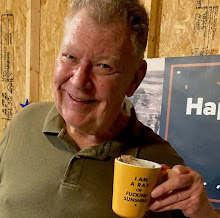
There is no whiskey-making tradition in the world in which the whiskey-maker uses beer made by someone else, yet that is one of the precepts of Bill Owens, President and High Priest of the American Distilling Institute (ADI).
I kid Bill with the High Priest thing because he and ADI could do all of their fine work without ever making the outrageous suggestion that micro-distillers should make whiskey using wash supplied by a brewer. Instead he has not only made the suggestion, he has elevated it to an article of faith.
"We already have 1,500 micro breweries in this country making wort/wash from barley," says Bill at every opportunity. "Why reinvent the wheel?"
No one denies that there are many places where one can obtain a barley malt wash and in the most technical and literal sense, a person who runs something through a still is a distiller, but I maintain that such a person is, at best, half a craft whiskey-maker. "Half" is probably too generous, because all of the flavor that will be in the final distillate is created in the fermenters. All the still does is concentrate flavors that are already there. How can you say you are the creator of a whiskey if you didn't create any of those flavors?
Since all whiskey except corn whiskey must be aged, the oak barrel is the other source of flavor, but you didn't make that either, did you? So where exactly is the craft in what you are doing? I won't say there is none, but since every major whiskey-maker makes its own beer, how can you claim to be more craft than they?
There are many micro-distillers in America who do not follow Bill's guidance on this matter. I do not want to suggest that all micro-distillers buy wash. They don't. Many are grain-to-bottle producers and I salute them.
An inevitable corollary to Bill's "buy beer" precept is "make malt whiskey," since what most brewers use to make beer is barley malt. Malt whiskey is what they make in Scotland, Ireland and Japan, but rarely in the USA. That means a fledgling American micro-distiller who follows Bill's advice is going against the grain in two critical ways. By not using the primary and uniquely-American ingredient in American whiskey: corn. And by not making the beer, which is contrary to every whiskey-making tradition in the world.
ADI does not mention this, an oversight I hope I have just rectified.

Monday, December 29, 2008
North Carolina Isn't the Problem.
My brother, who lives in North Carolina, tipped me to a story in the News & Observer about a new micro distillery that is being proposed for Chapel Hill. The distillery's proprietor, Scott Maitland, operates a local brew pub called Top of the Hill. The article was written by a News & Observer staff writer, Jesse James DeConto. It was published today. You can read it here.
I wrote to Jesse the following:
Dear Jesse,
I enjoyed your article about Scott Maitland’s proposed distillery and micro distilleries in general. I am a writer who specializes in American whiskey and I have been following the development of the micro distillery industry with interest.
Mr. Maitland may have given you the wrong impression about North Carolina’s liquor laws. Everything was explained correctly, but it gave the impression that North Carolina is unique, or at least unusual and out of the mainstream in its approach. North Carolina is a control state but the issues Mr. Maitland complains about are pretty much universal. In both control and license states; the producer, distributor and retailer must be separate entities. There can be no cross-ownership. Producers may not sell directly to retailers. Each state is slightly different, and the differences can make you crazy, but the three-tier distribution system is the norm in all 50 states. The exception is control states where the state is both distributor and retailer (for off-premise sales). The state can do cross-ownership but non-state entities cannot.
In Kentucky and Tennessee, where 99% of America’s whiskey is produced, if a distillery wants to sell its products to tourists in the distillery’s gift shop, it must sell them to a distributor, who sells them back to the retailer entity the producer has established. In Kentucky and Tennessee, the state made a special exception to the cross-ownership prohibition to allow even this, since in this case the producer is also the retailer. Most states also exercise some control over prices at every level.
It’s all about taxes. Every state, as well as many cities and counties, takes a big rake off of all distilled spirits sales. Distilled spirits, dollar for dollar, are one of if not the most heavily taxed consumer product on the market. This is not unique to North Carolina. Every distiller’s biggest tax payments go to the federal government through a tax on production known as the Federal Excise Tax. In North Carolina, that mark-up between what the ABC pays the producer and what it charges retailers is essentially tax.
Mr. Owens, who I consider a good friend, can also be very misleading on this subject. His emphasis on brewing as a precursor to whiskey making is his personal vision, not universally shared. Among all of the Master Distillers at the major American whiskey producers, only one has ever worked as a brewer.
If you follow Bill’s point of view a little further, he believes micro-distillers should make malt whiskey, not bourbon or rye, because malt is the easiest grain to ferment and distill, and because you can even buy wash from a brewery and avoid fermentation altogether. Bill takes these positions despite the fact that they are contrary to 200+ years of American whiskey-making tradition.
Feel free to contact me if you’d like to go into this further.
I wrote to Jesse the following:
Dear Jesse,
I enjoyed your article about Scott Maitland’s proposed distillery and micro distilleries in general. I am a writer who specializes in American whiskey and I have been following the development of the micro distillery industry with interest.
Mr. Maitland may have given you the wrong impression about North Carolina’s liquor laws. Everything was explained correctly, but it gave the impression that North Carolina is unique, or at least unusual and out of the mainstream in its approach. North Carolina is a control state but the issues Mr. Maitland complains about are pretty much universal. In both control and license states; the producer, distributor and retailer must be separate entities. There can be no cross-ownership. Producers may not sell directly to retailers. Each state is slightly different, and the differences can make you crazy, but the three-tier distribution system is the norm in all 50 states. The exception is control states where the state is both distributor and retailer (for off-premise sales). The state can do cross-ownership but non-state entities cannot.
In Kentucky and Tennessee, where 99% of America’s whiskey is produced, if a distillery wants to sell its products to tourists in the distillery’s gift shop, it must sell them to a distributor, who sells them back to the retailer entity the producer has established. In Kentucky and Tennessee, the state made a special exception to the cross-ownership prohibition to allow even this, since in this case the producer is also the retailer. Most states also exercise some control over prices at every level.
It’s all about taxes. Every state, as well as many cities and counties, takes a big rake off of all distilled spirits sales. Distilled spirits, dollar for dollar, are one of if not the most heavily taxed consumer product on the market. This is not unique to North Carolina. Every distiller’s biggest tax payments go to the federal government through a tax on production known as the Federal Excise Tax. In North Carolina, that mark-up between what the ABC pays the producer and what it charges retailers is essentially tax.
Mr. Owens, who I consider a good friend, can also be very misleading on this subject. His emphasis on brewing as a precursor to whiskey making is his personal vision, not universally shared. Among all of the Master Distillers at the major American whiskey producers, only one has ever worked as a brewer.
If you follow Bill’s point of view a little further, he believes micro-distillers should make malt whiskey, not bourbon or rye, because malt is the easiest grain to ferment and distill, and because you can even buy wash from a brewery and avoid fermentation altogether. Bill takes these positions despite the fact that they are contrary to 200+ years of American whiskey-making tradition.
Feel free to contact me if you’d like to go into this further.
Tuesday, June 24, 2008
You Meet the Most Interesting People.

When I brought the mail in today there was in it an envelope from a New York art gallery. I opened the envelope and extracted a large card with this image on it.
I stared and stared. Great image, I thought. Then I thought, “it’s Bill, it has to be Bill, let it be Bill.” I turned it over.

I’ve always known about Bill’s photography because of his most famous work, Suburbia, a now-classic 1972 book of photographs that was reissued in 1999. To explain it beyond the title would be redundant.
But I know Bill Owens for a completely different reason.
Bill is the founder of the American Distilling Institute (ADI). ADI calls itself "the collective voice of the new generation of progressive beverage, medical, and aromatic distillers, and is dedicated to the mission of disseminating professional information on the distilling process." You can find out more at www.distilling.com.
There are quite a few fascinating people in ADI, and Bill Owens is one of them.
Bill is from Northern California. He began to mess around with cameras in the 1960s while in the Peace Corps. He later worked as a photographer for various San Francisco-area newspapers, but shot fine art photography in his spare time.
At some point, Bill also began home-brewing, then started a brewpub called Wild Bill’s. If not the actual first it was one of the very first brewpubs in the country. Then he started a magazine called American Brewer, a journal for professionals and home-brewers, which spawned a short-lived (1995-96) enthusiast monthly called BEER, The Magazine, for which I wrote a few articles about whiskey.
Born in 1938, Bill decided a few years ago to sell everything and retire. He quickly became bored and started the ADI, which now has several hundred members in 36 states and Canada. Bill has thrown himself into it completely, like he does with everything.
Bill’s other books of photography are Our Kind Of People (1975), Working - I Do It For The Money (1977), and Leisure (2004). The events at the James Cohan Gallery are timed to coincide with the release of a new book, titled simply Bill Owens.
Not long ago, Bill came across a black-and-white picture of himself as a very young boy, wearing nothing except a pair of jockey shorts. He wanted to share the discovery with all of his friends but felt it needed a companion shot of the boy today in, naturally, nothing except a pair of jockey shorts. He’s very fit for a 70 year old man, but I really didn’t need to see that.
Some time later I said something to him about it and his reaction was like, what else could I do? The boy in the first picture had required that the second one be taken.
That's Bill.
Subscribe to:
Posts (Atom)