Monday, July 11, 2022

The Death of James C. Crow and the Birth of Aged Bourbon Whiskey


Grave of James Christopher Crow; Versailles Cemetery; Versailles, Kentucky.

Although death is always the end of something, it can cause something else to begin. That is what happened when James Christopher Crow, 67, died in Woodford County, Kentucky, in 1856. 

Crow was a professional distiller, itself something new. He didn’t have a farm, mill, or distillery of his own. His was an itinerant profession, plied at various distilleries in Central Kentucky from the 1820s until his death. 

In those days, few whiskey-makers were known beyond their home communities, but Crow and whiskey he made at Oscar Pepper’s distillery at Versailles (Vur-SALES is the local pronunciation) had a national reputation. The fascination with Crow and his whiskey began the connection between whiskey and Kentucky in popular consciousness. It also was the beginning of a new style of whiskey, bourbon whiskey as we know it today.

The site of Oscar Pepper’s distillery is today’s Woodford Reserve. 

James Crow is often cited as the  father of bourbon. Sometimes, that title is given to his banker, E. H. Taylor. The little-known William Mitchell is another likely candidate. (Elijah Craig is not a likely candidate. That story is bullshit.)

But it all starts with Crow. 

You may think you know Crow's story and perhaps you do, but you probably don't know all of it, and most people don't know what happened next nor how big Old Crow Bourbon ultimately became. But you will if you read the new issue of The Bourbon Country Reader (Volume 21, Number 2).

Also, a rye varietal revered by whiskey makers a century ago, known as Rosen, has returned to its roots in Michigan, literally.

Click here to subscribe.

The Bourbon Country Reader is the oldest publication devoted entirely to American whiskey. It is a charming mix of news, history, analysis, and product reviews. Do you worry that advertising spending influences coverage in other publications? No chance of that here since The Bourbon Country Reader is 100 percent reader-supported. It accepts no advertising.

To experience The Bourbon Country Reader for yourself, you need to subscribe. Honoring history, The Bourbon Country Reader still comes to you exclusively on paper, in an envelope, via the USPS. Doing our part to keep the USPS solvent, we use only First Class Mail, which just went up, again, so there is a whiff of subscription price increase in the air.

Nevertheless, a subscription to The Bourbon Country Reader is still a mere $20 per year for addresses in the USA, $25 for everyone else. The Bourbon Country Reader is published six times a year, more-or-less, but your subscription always includes six issues no matter how long it takes. For those of you keeping track, this new one is Volume 21, Number 2. 

Click here to subscribe with PayPal or any major credit card (the fastest and easiest way). Or click here for other options and more information (the slightly more difficult way). Click here for a free sample (an older issue in PDF format). Click here to open or download "The Bourbon Country Reader Issue Contents in Chronological Order." (It's like an index.)

If you want to catch up on what you've missed, bound back issue volumes are available for $20 each, or three for $50. That's here too. (Those prices are probably going up soon too.)

If you prefer to pay by check, make it payable to Made and Bottled in Kentucky, and mail it to Made and Bottled in Kentucky, 3712 N. Broadway, PMB 298, Chicago, IL 60613-4198. Checks drawn on U.S. banks only, please.

Sunday, July 3, 2022

Does that NDP Whiskey Really Have a NDA?


Bound by a NDA, or lying?
A non-disclosure agreement (NDA) is a legal contract covering confidential information the parties wish to share with each other, but with restrictions on wider sharing. In the whiskey world, when you try to find out who made something, a non-distiller producer (NDP) may tell you that information is confidential because of a NDA? Is the NDP really prevented from revealing the whiskey's source or sources because of a NDA?

Probably not.

By its nature, the use of NDAs in the world of NDPs is tough to research, but the distilleries that provide most of the whiskey bottled by NDPs say they don't require them. In fact, distillers like MGP/Luxco, Tennessee Distilling Group, Bardstown Bourbon Company, and Green River Spirits encourage their NDP customers to tell their customers where the whiskey was made.

Producers who sell into the bulk market, often through brokers, are proud of their products, but also professionally discrete. As business-to-business producers, they consider that information as the customer's, for the customer to reveal or conceal, at the customer's discretion. They won't tell you, except in general terms, who their customers are or what they make for them. In many if not most cases, they don't know what happens to their liquid after it leaves their control so they have nothing to talk about. Their discretion is appropriate.

If most producers don't require NDAs, why do so many NDPs claim to be bound by them?

They're lying.

The only distillers who have much incentive to require NDAs are the majors. If Jim Beam, Jack Daniel's, Wild Turkey, Maker's Mark, or one of the other brand name producers sells some excess whiskey, as they all do, they don't want the buyer to start advertising their 'Jim Beam' bottling. If there is a NDA in such a case, it may not require absolute secrecy. You can, for example, find bottlings of COSTCO's Kirkland Bourbon that say 'Clermont, Kentucky' on them. That is obviously Jim Beam liquid, but they're not using the Jim Beam name. No doubt, Beam-Suntory's purchase agreement with the broker who ultimately sold the whiskey to COSTCO contained some non-disclosure wording.

Does that mean we should always interpret a NDP-NDA claim as indication of a major producer source? Dave Pickerell, when he was first promoting WhistlePig, claimed a NDA prevented him from revealing the name of the Canadian distillery that made it (Alberta) even as he told you who it was with a wink and a nudge. He was bound by a NDA and he honored it, but it was more about discretion than secrecy.

These days, although all of the majors occasionally offload surplus liquid, usually with some level of disclosure restriction, it's a drop in the NDP bucket. You may safely assume 90 percent or more of the NDP whiskey in the market is not bound by any kind of NDA. The claim of a NDA is almost always for the NDP's interest and convenience.

Why? Because we still have too many NDPs who try to pretend they're makers, not fakers. When you point out they don't have a distillery, they feed you some double-talk about "cooking in someone else's kitchen."   

So while some NDA claims are true, most are not, and the most adamant are the least likely to be true. Regard the claimants accordingly. If they are keeping their sources a deep, dark secret, there is a reason. The secret the NDP is protecting is the NDP's, not the producer's.
 
Consider also NDPs who always reveal their sources. Ever wonder how they are able to avoid those dreaded NDAs?

Thursday, June 30, 2022

Bardstown Bourbon Company Buys Green River


Maturation warehouse at the Green River Distillery, Owensboro, Kentucky.

It was announced today that Bardstown Bourbon Company is buying the Green River Distillery in Owensboro, as well as Green River's bottling, blending, and product development facility in Charleston, South Carolina. Whiskey enthusiasts want to know what it means. Mainly, it means creating a major whiskey producer from scratch, and apparently in a hurry, takes a lot of scratch, as in capital, which Bardstown Bourbon Company clearly gained access to with its sale to Chicago's Pritzker Group earlier this year.

There is a long tradition of Kentucky distilleries seeking and finding capital in Chicago. Jim Beam did it. So did the descendants of Tom Moore, whose distillery in Bardstown is today's Barton 1792. The alternative is sale to one of the major distilled spirits producers. Heaven Hill recently bought Samson & Surrey. MGP bought Luxco. Constellation owns Nelson Brothers and High West. Pernod owns Jefferson's, Smooth Ambler, Rabbit Hole, and Firestone & Robertson. Who's next? New Riff? Wilderness Trail? Sagamore Spirits? Jackson Purchase?

The majors don't buy production facilities, they buy brands, which Bardstown Bourbon and Green River don't have. After Green River adopted that name and walked away from that TerrePure rapid-aging business, they began to position themselves exactly like Bardstown Bourbon, as the best place for a non-distiller producer to create and build a brand. The hook-up was a natural.

Ample capitalization makes the new combination less dependent on contract distilling and better able to invest in brand development for its own portfolio, while socking away whiskey to mature, to use when it's ready, either in their own brands or for that most profitable kind of bulk sales.

Some people will foresee in this omens of doom. Others will gleefully chant, "glut, glut, glut." 

The reality is, there is a lot of whiskey being made. That's nothing new, and not just here. Whiskey is up everywhere. We've been in this boom, by some estimates, for two decades already. Prices aren't softening. Everybody is booked up with contract work. Everybody is adding capacity. Whiskey in every maturity segment, from young whiskey going into the flavored and ready-to-drink products, up to and including once-rare 'teenagers' (anything north of 12-years-old), is available and selling, with older stuff more scarce, of course. At the moment, there are a few bottlenecks. Everybody is having trouble getting bottles and barrels. Grain prices are high because of the war, but availability doesn't seem to be a problem. Maturation warehouses are going up at a rapid clip, Buzick is busy; but don't worry, Kentucky isn't running out of land. 

Bardstown Bourbon Company was a literal green field project. Nothing was there when they began construction. Green River operated as Medley Brothers until 1992 and has history back to the 19th century. It got a major re-do after Terressentia bought it. Both distilleries have been producing since 2016, and their liquid is solid, so this sale won't change anything in terms of how much whiskey is available in the marketplace. 

What seems to be shaking out is we will have boutiques and bigs, that's it. All in all, business as usual. If there is anything unusual about this moment, it is the speed with which all this is happening. By it's nature, the whiskey business is used to a more leisurely pace. 


Monday, June 27, 2022

Michigan Celebrates Rebirth of Rosen Rye with Official Proclamation

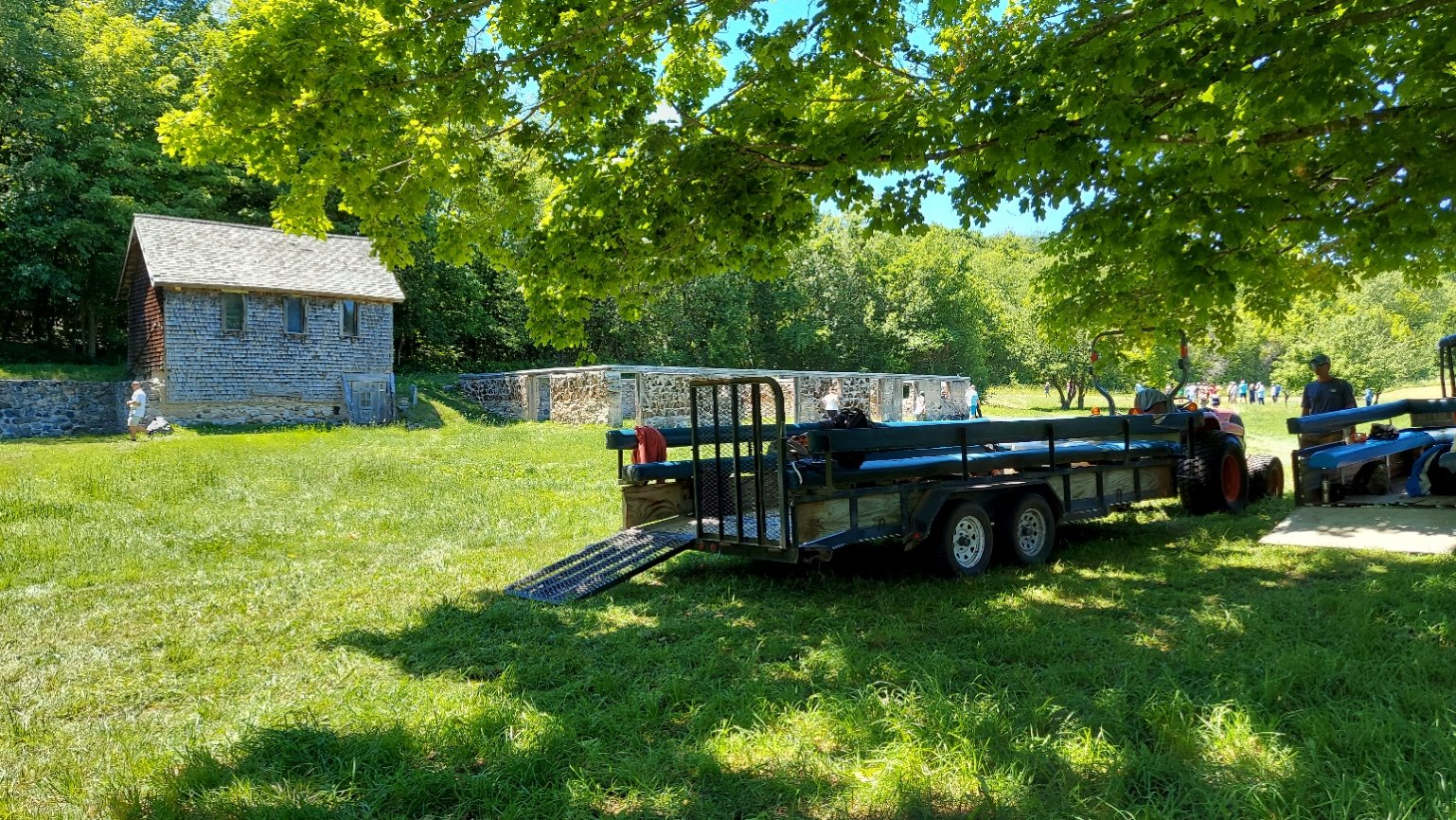
Ice house and barn foundation on South Manitou Island, Sleeping Bear Dunes National Lakeshore, Northern Michigan. Rosen Rye Day 2022. Party bus in foreground.

MICHIGAN SENATE

Senate Resolution No. 160

Offered by Senators Victory, Bayer, Huizenga, Santana and Wojno

A RESOLUTION TO RECOGNIZE JUNE 23, 2022,
AS “ROSEN RYE DAY”

WHEREAS, Michigan’s food and agriculture system is a major contributor to income and employment in the state’s economy, accounting for over $100 billion in direct, indirect, and induced economic activity and over 800,000 jobs; and

WHEREAS, Since its admission to the union in 1837, Michigan has been an important producer of cereal grains including wheat, corn, and rye. In 1909, a new rye varietal was brought to Michigan Agricultural College (MAC) from Russia by Joseph Rosen and subsequently cleaned, selected, and propagated by Professor Frank Spragg; and

WHEREAS, It was determined conclusively that Rosen Rye vastly outperformed common varietals and that its cultivation become a priority for Michigan’s agricultural community; and

WHEREAS, Beginning in 1917, significant exports of “Certified” Rosen Rye seeded around the world, and notably to major whiskey producing regions of the United States. By 1920, Michigan was the nation’s largest producer of rye; and

WHEREAS, It became apparent that, despite universal acclaim, Rosen Rye crops diminished in quality from year to year due to cross-pollination from contact with common rye. A decisive action needed to be taken to isolate the finest seed-stock and protect the innovations and investment of Michigan’s agricultural community. In turn, a survey was formed to determine suitable, isolated areas and South Manitou Island was found to be ideal; and

WHEREAS, George and Louis Hutzler, along with Irvin Beck, led all seven farms on South Manitou Island and formed a mutual pact, swearing under penalty of drowning, to grow only Rosen Rye to protect its genetic purity. Over the following decade, they earned numerous international awards for “Certified” Rosen Rye, garnering the farmers the moniker “Rye Kings” and Manitou Island as the “World’s Rye Center”; and

WHEREAS, Between the dawn of Prohibition, and the 1960s when the last farmers left South Manitou Island, Michigan Rosen Rye was venerated in whiskey advertisements, extolled in internal distillery production manuals, and raised to legendary status in bootlegging folklore, before completely disappearing from the market for 50 years; and

WHEREAS, Under permit from the National Park Service, using seeds from the United States Department of Agriculture Seed Bank, along with assistance from Michigan State University’s Department of Bio Ag Research and volunteer descendants of the Hutzler and Beck families, Mammoth Distilling has revived these historic farms to reintroduce “Certified” Rosen Rye; now, therefore, be it

RESOLVED BY THE SENATE, That the members of this legislative body recognize June 23, 2022, as “Rosen Rye Day”; and be it further

RESOLVED, That we recognize the critical role of native grains and locally grown agriculture to the success of the craft spirits industry in Michigan.

Adopted by the Senate, June 23, 2022.

Margaret O'Brien

Secretary of the Senate


Monday, June 13, 2022

My Bourbon Epiphany


I'm often asked what prompted me to start writing about bourbon. I always talk about living in Louisville and working in the industry, and about how my parents always drank bourbon. But there is a chicken-egg aspect to the story I've only just realized. 

My move to Louisville was for a job and with a plan that had nothing to do with bourbon. I was 26 and not a bourbon drinker. Mostly, I drank beer, but my spirit of choice was cheap blended scotch and I had just begun to flirt with single malts. 

When I walked into the liquor store nearest my new home and saw a wall full of different bourbons, I thought "what the hell" and never looked back. I never would have written about bourbon if I hadn't fallen in love with the drink first and I might not have done that if I had not moved to Louisville when I did. 

(And one of the reasons I was in a hurry to move to Louisville was to get my girlfriend away from another guy, but that's a whole different story.)

I have a vivid memory of that exact moment, the little storefront package store on Brownsboro Road, near Zorn. The bourbon wall was to the left. I remember the front of the store was glass, close to the street, so I picture it as dark, with cars rushing past just a few feet away. 

Growing up in Ohio, I was used to state stores. Self-service in a liquor store was new to me, let alone this. It was a tiny space packed with merchandise, most of it bourbon, or so it seemed. Beer was in a cooler in the back. The first thing I grabbed, right out of the box, was Old Forester because it was the first label I recognized. 

The moment was overwhelming but it sure said, "Welcome to Kentucky."


Thursday, June 9, 2022

Finished Whiskeys Feed the News Monster


Legent is Kentucky Straight Bourbon Whiskey
Partially Finished in Wine and Sherry Casks.

Marketing copywriters are taught the power of certain words. They’re obvious. You see them all the time. Short, sharp shots, they practically demand their exclamation points: Save! Sale! Now! New! Improved! Free! Easy! More!

Of these, the most pernicious is ‘New!’ and its corollary, ‘News.’ This is especially true for whiskey products, since whiskey is supposed to be old. “People like fresh strawberries, but no one wants fresh bourbon,” a wise, old sales manager once said. He also said, “That may be clever, but will it move one more case of brandy?”

So, whiskey marketers struggle to create news even as the media maw demands more. Even the giants can launch only so many new brands. A genuinely new whiskey takes years to come to market. You can buy advertising to promote anything, but if you want ‘buzz,’ if you want free media coverage, social or otherwise, you need to constantly answer the question, “what’s new?”

It isn’t just consumers and the press who demand news, so does the trade. “I need a reason to start a conversation,” pleads every frontline salesperson to their marketing department. News gets you appointments, which gets you placements, maybe an end-cap, maybe an ad. 

Marketing restrictions unique to the liquor business complicate this problem, since many of the common sales promotion tactics used to generate news in other product categories, things like coupons, BOGOs, bonus packs, co-packs, games, sweepstakes, gift-with-purchase, sponsorships, etc. are off-limits. They are either prohibited entirely or limited to a patchwork of states. National promotions, applicable everywhere, are impossible. Spirits brands can do worthy cause tie-ins, which are worthy and all, but they don’t move cases.

So, we have expressions, limited or ongoing. Some twist on an existing brand.

For producers, the most popular expressions are the easy ones. Two categories seem to dominate. Both involve adding flavor to a mature whiskey, either through a secondary wood finish, or flavoring materials. 

Some whiskey enthusiasts are purists who won’t consider anything labeled “bourbon whiskey with…” Others will try anything. A third group distinguishes between finishes and flavorings, considering the former consistent with historical practice, but the latter an abomination. This leeway is granted because although secondary wood finishes were exceedingly rare in American distilleries until recently, they have long been accepted in Europe. 

After all, whiskey is, by definition, a grain distillate flavored by wood. 

In just about every case of a secondary wood finish you can easily look up what woods were used, how long they were finished, exactly what techniques were used, and other background music. Producers love to tell you that stuff, but it's just filler. It’s not important. It doesn’t tell you anything useful. Knowing there was a secondary wood finish tells you the whiskey will taste different, but bourbon finished in Calvados brandy casks doesn't taste like Calvados, so knowing what Calvados tastes like, or even liking Calvados, tells you nothing about whiskey finished that way. It will taste different, just not in a predictable way. If you expect it to taste like Calvados, you'll be disappointed.

All that matters is, does it taste good? Most of all, does the finish enhance the flavor of the bourbon, which should remain the star, or does it get in the way? A press release won’t tell you that, you have to taste it.

What if you could compare the finished whiskey to its un-enhanced counterpart? Would that tell you what the finish contributes? Yes, indeed. Legent, for example. This Beam Suntory finished bourbon has Jim Beam as its starting point. It does taste different, and good. Is it worth the extra money? At Binny’s in Chicago*, Jim Beam Black Label is $21, Legent is $35. That’s a hefty upcharge. Worth it? Maybe not the right question. The right question is, how well do you like Legent compared to other $35 whiskeys? If secondary wood finishes are ‘okay’ with you, i.e., acceptable, don’t just compare them to other finished whiskeys, compare them to everything in their price range.

That whiskey finished in Calvados brandy casks? That’s Blood Oath, Pact No. 8, from Luxco/MGP. The base bourbon is probably comparable to some of the higher-end Yellowstone or Ezra Brooks expressions. They pull from the same barrel inventory. Again, you can go into the weeds about what and how, it doesn't matter. In this case, it doesn’t matter because fewer than 20 thousand bottles were released and prices from legitimate sellers (Binny’s doesn’t have it) range from $400 to $800. That said, it’s a nice drink, well-balanced considering its disparate elements. Too bad most bottles of it will gather dust in a trophy case.

Which brings us to the granddaddy of all secondary wood finishes, Angel’s Envy. When Lincoln Henderson created it way back in 2011, it seemed like a clever way to take the bulk bourbon available to him at the time and make it distinctive, more than the sum of its parts. It was a product they could bring to market quickly, to make some money until they could get their own distillery built. Henderson had the master’s touch. The port casks contribute noticeable sweetness and dark fruit notes, but it still tastes like bourbon. No one has done it better. Today Angel’s Envy is a major brand in its own right, owned by Bacardi, and secondary wood finishes are all they do.

No brand has fought harder against the news monster than Maker’s Mark. The core tenant of the faith is that Maker's is the best whiskey there is so, by definition, there cannot be a 'better' expression of it, just a 'different' one, hence different proofs and finishes. Maker’s 46 illustrates the principle effectively for a modest upcharge. Regular Maker’s is $30, Maker’s 46 is just $34. On the other hand, a Binny’s Handpicked Maker’s Private Selection is $70.

Taste enough secondary wood finished whiskey and a few things become clear. A subtle finish on a solid base whiskey is most likely to satisfy, a finish can’t fix bad whiskey, some finished whiskeys are better than others, and the rigmarole of how they got there is not important except as homage to the news monster.

______________________

* Binny's is used for price comparisons because it is a major chain retailer in a major market, in a state that doesn't fix prices, so it's a good baseline for price comparisons. Your results may vary.

Friday, June 3, 2022

What Does a Distillery Taste Like?


Beam Suntory's Booker Noe Distillery, Nelson County, Kentucky.

One way to think about tasting whiskey is to think about tasting distilleries. Most distilleries sell multiple expressions of their whiskey. Some also make multiple recipes. 

Beam Suntory, for example, makes three basic bourbon recipes, Jim Beam, Maker's Mark, and Old Grand-Dad. The representative expression of the Jim Beam recipe has to be white label, but what's the best expression? Black label? Knob? Booker's?

Secondary wood finishes destroy the paradigm, so we'll ignore them.

This is not, "What is the most representative expression?" It is what is the best representative expression? What is the easiest way to taste a given distillery's best work? With 'easiest' defined as available and affordable. So in addition to secondary finishes, we'll leave out limited editions, unicorns, and dusties.

I'm fickle about this, which is why I'm opening the floor. If you've never tasted the Jim Beam recipe before, where is the best place to start? White Label? I tend to say Black Label, but a case can be made for Knob, or something else.

But for Wild Turkey, I say start at the top with Kentucky Spirit. That doesn't make sense, but it's what my gut tells me. Four Roses too, go for the Single Barrel. In general, single barrels are a good way to 'taste the distillery' because there is nowhere to hide. The maker can't 'fix' things with blending.

Buffalo Trace is easy. They have consistently put some of the best whiskey they make into their eponymous brand. Their only problem seems to be making enough of it. 

Maker's Mark is equally easy. Everything except standard Maker's Mark is a secondary wood finish, so ruled out for purposes of this exercise. That's deliberate. The core tenant of the Maker's Mark faith is that Maker's is the best whiskey there is so, by definition, there cannot be a 'better' expression of it, just a 'different' one, hence finishes.

Evan Williams Single Barrel Vintage has always seemed Heaven Hill's standard bearer, but its star has faded. Is Elijah Craig Heaven Hill's exemplar today? That's another good word for this exercise. What is each distillery's exemplar?

A distillery should have an exemplar, a standard bearer, a flagship. Unfortunately, the industry's commercial nature dictates that success determines the flagship. Brown-Forman will always officially equate 'flagship' with its founding brand, Old Forester, even though Brown-Forman's real flagship is Jack Daniel's Old No. 7. But is Old No. 7 the best thing Jack makes that is available and affordable? You tell me.

What do you think is the best way to taste this or that distillery? Recommend whatever you want. Since we're tasting distilleries, your recommendation won't be very useful if you don't know where it was distilled. But I'm not going to curate this any more than I usually do, which is hardly at all. Recommend whatever you want.

Take price and availability into consideration. We're talking drinkers, not collectibles.

This isn't an assignment. I'm not suggesting you need to go through every recipe at every distillery. In fact, don't. Please don't. But if you have something useful to share, share it.

The idea is that if you're trying to try different things, how do you make sure you really are trying different things. Beam Suntory had an excellent advertorial in a magazine recently in which they made great suggestions for trying different whiskey combinations, all of which just happen to be made by Beam Suntory. That seems to be their strategy now, to flood the market with new expressions.

The same thing can happen if you try to do it yourself in a liquor store. You might find yourself tasting the same whiskey in five different bottles. That's what we're trying to help people avoid.

So, readers, you have the floor.