Friday, February 4, 2022

Whiskey History and Why It Matters


Keebler CEO Ernie Keebler, flinging fudge in front of his cookie factory.
June, 2022, will mark the 30th anniversary of the premiere of "Made and Bottled in Kentucky," the documentary about bourbon that I made for KET (Kentucky's public television system) to celebrate the bicentennial of Kentucky statehood. KET still shows it from time to time.

It effectively marks how long I have been writing about bourbon. From the beginning, my primary interest has been history, the history of American whiskey and that history's many intersections with American history. When I have been in conflict with producers, that's usually why. The temptation to corrupt history for profits seems irresistible. 

In 2007, Diageo rolled out some new marketing for George Dickel Tennessee Whiskey. They had invented a fanciful tale about George Dickel and his new bride, Augusta, visiting Coffee County in 1867, where George dreamed about "creating the finest, smoothest sippin’ whisky," and then started a business there in 1870. It was full of other ridiculous and unsupported claims. 

Does is matter? I think it does. Here is why. 

The Keebler Elves were created in 1968 by the Chicago-based advertising agency, Leo Burnett Co. One of Leo's hallmarks was his use of mascots; fictional and, usually, illustrated characters who personified a brand's advertising proposition. A half-century later, Ernie and crew are still making cookies in the hollow tree.

The difference between Ernie Keebler and George Dickel is that George Dickel was a real person. So was Augusta Banzer Dickel, who had a younger sister, named Emma, who married George Dickel's business partner, Victor Shwab. All real people. No one is expected to believe that Ernie Keebler is CEO of a cookie company whose factory is in a hollow tree and no one does. But when the makers of a brand make historical claims about real people, we're expected to believe them, aren't we?

Not only were those people real, with real histories, but the things they did matter. The history of commercial enterprises may not be as significant as the history of governments, but they are part of the overall story of how we developed as a nation and people. The history of America's beverage alcohol industries may be more important than most because they contributed so much to the nation's development. Beverage alcohol is the only industry that has prompted two constitutional amendments. 

When Diageo treats important historical figures such as the Dickels and Shwabs as if they are cartoon elves, they do a disservice to the product and the industry. (They have cleaned up their act somewhat since. The newlyweds and their carriage ride are gone.)

The practice of playing fast and loose with whiskey history is not unique to Diageo. Far from it. Virtually every company that sells American whiskey is guilty of at least some fudging. Many of the things Brown-Forman says about Jack Daniel's are unproven and probably unprovable. They call them "Legends and Lore" to give themselves an out. Jim Beam has no evidence that, as they often claim, "Jacob Beam sold his first barrel of whiskey in Kentucky in 1795."  

Heaven Hill falsely claims that Elijah Craig invented bourbon and that Evan Williams was Kentucky's first distiller. Sazerac falsely claims that William Weller invented wheated bourbon. Diageo falsely claims that the Bulleit Bourbon recipe originated with Augustus Bulleit in the 19th century. The people are all real, the claims are all false.

I can't complain too much because all this misrepresentation gives me something to do. If you want the real history of American whiskey, you pretty much have to get it from people like me, because you can't trust the producers.

(I recommend Bourbon, Strange. Surprising Stories of American Whiskey, where you will find a 36-page chapter entitled "George Dickel and the Trouble with Diageo," followed by a 19-page chapter entitled "Fact and Fiction in Bourbon History." If you like that sort of thing.)


Wednesday, January 26, 2022

Why the George Remus Bourbon Brand Is a Terrible Idea


Murderer George Remus and his victim, in happier times. (1907)
This is a tease post for the latest issue of The Bourbon Country Reader, where we cover the Remus issue in some detail, but I won't make you subscribe to get the payoff.

George Remus was a criminal, a crook who happened to deal in whiskey. He was caught, convicted, and imprisoned. He was also a murderer and the victim was his wife.

The violence against women aspect makes the Remus story particularly problematic for the brand. From social media and other sources, it appears some consumers like that part of the lore. “Bitch had it coming,” is the common sentiment. 

MGP/Luxco, the company that sells George Remus Bourbon, has done nothing to encourage this, but when that kind of noise is attached to your brand, it can only end badly.

In principle and in general, it is a bad idea to link legal businesses to criminals and crime, but it is an especially bad idea for makers and sellers of alcohol.

That's it. That's the preview. If you want the rest, subscribe. 

But wait, there's more! 

Also in this issue, "Tennessee Whiskey. It's Not Just Jack Daniel's Anymore," in which we survey recent goings-on in the Volunteer State. Also, expansion at Wilderness Trail, and whiskey distilleries making a green walnut liqueur. 

The new issue of The Bourbon Country Reader will go into the mail in the next few days. Click here to subscribe via PayPal (PayPal account or any major credit card, U.S. address only). Click here for other options (including for a non-U.S. address) and more information about the newsletter itself.

The Bourbon Country Reader is the oldest publication devoted entirely to American whiskey. It is a charming mix of news, history, analysis, and product reviews. Do you worry that advertising spending influences coverage in other publications? No chance of that here since The Bourbon Country Reader is 100 percent reader-supported. It accepts no advertising.

To experience The Bourbon Country Reader for yourself, you need to subscribe. Honoring history, The Bourbon Country Reader still comes to you exclusively on paper, in an envelope, via the USPS. Doing our part to keep the USPS solvent, we use only First Class Mail. 

A subscription to The Bourbon Country Reader is still a mere $20 per year for addresses in the USA, $25 for everyone else. The Bourbon Country Reader is published six times a year, more-or-less, but your subscription always includes six issues no matter how long it takes. For those of you keeping track, this new one is Volume 20, Number 6. (The last one was in September so, yeah, sometimes we don't exactly keep to the schedule.)

Click here to subscribe with PayPal or any major credit card (the fastest and easiest way). Or click here for other options and more information (the slightly more difficult way). Click here for a free sample (an older issue in PDF format). Click here to open or download the free searchable PDF document, "The Bourbon Country Reader Issue Contents in Chronological Order." (It's like an index.)

If you want to catch up on what you've missed, bound back issue volumes are available for $20 each, or three for $50. That's here too.

If you prefer to pay by check, make it payable to Made and Bottled in Kentucky, and mail it to Made and Bottled in Kentucky, 3712 N. Broadway, PMB 298, Chicago, IL 60613-4198. Checks drawn on U.S. banks only, please.

Monday, January 10, 2022

Top 10 Best-Selling Distilled Spirits Brands in the United States, in 1971

But what were they drinking?
My fellow baby boomers will not appreciate being reminded that 1971 was half-a-century ago. Much has changed. We wore Nikes and polyester bell bottoms when we went skateboarding with Farah Fawcett, but what did we drink? The answer may surprise you. Here are the top 10 best-selling distilled spirits brands in the United States in 1971.

1.   Seagram’s 7 Crown (American blended whiskey)
2.   Seagram’s VO (Canadian blended whisky)
3.   Smirnoff (Vodka)
4.   Canadian Club (Canadian blended whisky)
5.   Bacardi (Rum)
6.   Gordon’s Gin (Gin)
7.   Jim Beam (Bourbon whiskey)
8.   Cutty Sark (Blended scotch whisky)
9.   Gilbey’s Gin (Gin)
10. (3-way tie) Dewar’s (Blended scotch whisky), Kessler (American blended whiskey), Calvert Extra (American blended whiskey)

Several things stand out. Seven out of twelve are blended whiskeys, three American, two Canadian, two Scottish. As for white goods, there is one vodka, one rum, and two gins. Jim Beam is the lone American straight whiskey. Jack Daniel's Tennessee Whiskey? It was Nowheresville 50 years ago, way back at #36. 

Another chart in the same presentation told me that the all-whiskeys share of the U.S. distilled spirits market in 1961 was 73.1 percent. By 1972, whiskey's share had declined to 62.1 percent. The all-non-whiskeys share increased similarly, led by vodka. Whiskey's crash was just getting started. Whiskey's share would continue to contract for another 20 years.

Today, only Smirnoff, Bacardi, and Jim Beam remain big category leaders. Seagram's Seven is still the #1 American blended whiskey but that segment is a fraction of its former self and the Jos. A. Seagram Company no longer exists. 

In 1971, I lived in Ohio, where 3.2 percent beer was legal at 18. I couldn't legally buy spirits until September of 1972. It was mostly Seven & Sevens (Seagram's 7 and 7Up) for me then, though I soon switched to J&B and other blended scotch. Although my parents drank nothing but bourbon, I didn't start until I moved to Kentucky in 1978, where it is required by law.

Not really, but when I showed up in Kentucky drinking cheap scotch, my friends would say, "why are you drinking that cheap crap when bourbon is even cheaper and a lot better," and they were right! That's how it all began for me. Then I wrote a book and everybody started to drink bourbon again. The end.

Today, Tito's and Smirnoff top the leader board. Crown Royal (Canadian blended whisky) is third and the only blended whiskey of any kind in the top ten. Jim and Jack are both top ten but so is Fireball. Four of the top ten are vodkas. Two are rums. There is no gin or scotch anywhere in the top 20. 

Now we know how it all played out, but if you studied this list in 1971 you might, despite knowing how much whiskey had fallen since 1961, still think whiskey looked pretty strong. That's why trend-spotting only looks easy in retrospect. 

Thursday, January 6, 2022

Are Basil Hayden and Old Grand-Dad the Same?


A little knowledge goes a long way. 

Are they? Short answer, no; but here is why this question is asked and why that ‘no’ is nuanced and will bear some explaining. (Fair warning: It may not need as much explaining as it's about to get.)

Basil Hayden is a brand that offers several different expressions, but its flagship is a straight bourbon bottled at 80° proof (40% ABV). Once upon a time it had an 8-year age statement. It is NAS (no age statement) now, but probably 6-9 years old in practice. The brand was created in the early 1990s as part of Jim Beam’s Small Batch Bourbons Collection.

Old Grand-Dad is a brand that originated in the 19th century. It was started by R. B. Hayden and had several different owners on both sides of Prohibition, eventually becoming part of Seton Porter’s National Distillers. In 1987, National sold all of its beverage alcohol assets to the parent company of Jim Beam, which landed Old Grand-Dad in the Beam portfolio.

Old Grand-Dad was just one of many brands Beam acquired in that deal, but it was unique. National’s other bourbons, such as Old Crow, were similar enough to Jim Beam that when the whiskey inventory acquired in the deal ran out, they could put Jim Beam liquid into Old Crow bottles and no one would be the wiser, which is exactly what they did (and no one was).

But they couldn’t do that with Old Grand-Dad because it used a different recipe, a particular yeast strain and a mash bill that contained about twice as much rye as Jim Beam and, consequently, that much less corn. If they put Jim Beam liquid into Old Grand-Dad bottles, it would taste different and people would notice. That would be bad because even in the dark days of the 1980s, Old Grand-Dad was considered a premium brand and was very profitable.

Bourbon pricing in those days was simple. ‘Value brands’ were the cheapest; your off-brands, house brands and generics. Next was ‘popular price.’ That’s where most of the major brands were, including Jim Beam. The highest category was ‘premium.’ Old Grand-Dad was considered ‘premium.’ The leader in the premium segment was Jack Daniel’s. The Beam marketing folks thought maybe they could ‘squeeze’ Jack Daniel’s with Grand-Dad on its upside and Beam on its downside, but that strategy went nowhere.

As the brand settled in, executives at Beam saw little opportunity to grow Old Grand-Dad, but they very much wanted to preserve what sales it had.

They didn’t guess about any of this. They meticulously researched it with consumers and concluded that the additional cost of producing a separate recipe would be offset by the estimated sales they would lose if they changed how it tasted. Spending more to keep it the same was worth the investment, so that's what they did; same yeast, same high-rye mash bill, same distillation proof, same barrel entry proof, everything. 

The only change was the distillery. Although the deal included the place where National had been making Old Grand-Dad, Beam didn’t need additional capacity so they moved distillation to Clermont. Owning the former distillery was good, however, because it gave them easy access to everything they needed to keep everything the same, including some of the crew who had been making it there. 

Today, Old Grand-Dad is straight bourbon bottled at four different proofs: 80°, 86°, 100°, and 114°. The 100° proof is bottled-in-bond. Old Grand-Dad doesn't have an age statement, so it is at least 4-years old. It’s probably in the 4- to 6-year range.

The story of the Basil Hayden brand starts with Booker’s Bourbon. That whiskey, with retired master distiller Booker Noe as its spokesperson, was one of the first to herald the bourbon renaissance. Its success prompted Beam to create the Small Batch Bourbons Collection. Booker’s was basically an extra-aged (6- to 8-year), barrel proof version of Jim Beam. Two other brands in the four-brand Collection, Knob Creek and Baker’s, also used the Jim Beam base distillate. It was decided that the fourth one would use the Old Grand-Dad recipe. 

At the time, Old Grand-Dad itself did not have an 80° proof expression, so they made the small batch version 80° proof and 8-years old, and named it after Basil Hayden, the actual grandfather of the brand’s founder and an important participant in the earliest history of Kentucky’s bourbon heartland. It was the lowest proof of the four, so they positioned it as an entry-level offering. “A good starter bourbon for scotch drinkers.” That was the idea.

Making Basil Hayden just an older version of 80° proof Old Grand-Dad, right?

This is where the nuanced ‘no’ comes in or, more precisely, ‘not exactly.’

One aspect of bourbon-making that many enthusiasts miss is the flavor profile. Beam has many thousands of barrels of the Old Grand-Dad base distillate aging in its warehouses. After aging, each barrel is a little bit different and mixing whiskey from different barrels together is how you create a flavor profile. 

Every brand, and every expression within a brand, has a flavor profile that must be maintained from batch to batch. They still do that the old-fashioned way, with human tasters who compare each candidate bottling batch to a standard for that expression. Maintaining the standard itself can be complicated but its essence is, “what it tasted like last time.”

Deciding which barrels to dump for bottling starts by identifying barrels that are the right age, but it doesn’t end there. Candidate combinations are done on a small scale, tweaked until they get it right, then scaled up to the hundreds of barrels and thousands of gallons that can make up a bottling run. Even after the scaled-up batch is prepared it is subjected to additional taste tests and tweaks before it goes into production. 

There probably is nothing producers take more seriously than consistency from batch to batch. That consistency also applies to appearance, but it’s mostly about taste and aroma.

If Basil Hayden’s flavor profile is different from Old Grand-Dad’s, and it is, then they are not the same whiskey. Remember that Beam's objective with Old Grand-Dad, for 35 years now, has been to keep it the same. Basil Hayden was a new brand and wasn't targeted at Old Grand-Dad drinkers. It was crafted to appeal to that bourbon-curious scotch drinker and other entry-level bourbon drinkers. So, yes, it's the Old Grand-Dad distillate, but used in a completely different way. In fact, the Basil Hayden profile is probably as far as you can get from the Old Grand-Dad profile using the same distillate.

Even within the Old Grand-Dad line, the various expressions aren’t just 114 plus different amounts of water. Each proof has its own flavor profile, its own standard, that must be matched. It may not be much more than adding water, but it’s a little bit more.

Of course, it isn’t just Beam Suntory that does this with Old Grand-Dad and Basil Hayden. It is every brand at every company. Every expression of every brand has a flavor profile, maintained from batch to batch as described above. The big producers have thousands of samples, in bottles, so they can reference not only the current standard but also go back and compare current batches to previous ones from just about any period in the brand’s history. These are the kind of crucial business records you can't digitize.

In a small craft distillery, tasting may solely be the distiller’s job, but typically there is a panel of people who do this regularly. Many receive special training.

Most distillers make more than one recipe and derive multiple brands and expressions from each of them. It is common for two or more brands to have the same base distillate, and that is a big thing to have in common. It is useful to know what some of these ‘recipe families’ are because if you like one expression in a given family you may also like others, and likewise that knowledge can suggest labels to avoid, but being in the same recipe family, even being generally similar, does not make them the same whiskey.

Not exactly.

Thursday, December 23, 2021

Over the River and Through the Woods


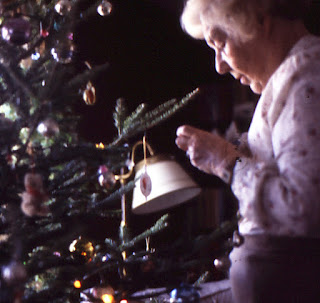
Edna Catherine (Schwartz) Bunsey (1904-1994)
As a kid growing up in Mansfield, Ohio, I did not have to cross a river or go through a woods to get to my Grandmother's house. Okay, I could go through the woods on my bike, and that route crossed a creek or two, but in the car with my family at Christmas, we probably went down Abbeyfeale, up Midland, to Gadfield, then Austin, left on Woodhill Road to Grandma's house at the corner of Woodhill and Andover.

This post mostly is about this picture of Grandma, as a way to say "Merry Christmas" to anyone who reads this blog, but of course it brings back memories.

This grandmother is my mother's mother. That is the family I grew up with. All of Dad's 'people' were in St. Louis or Central Illinois so we rarely saw them. Grandma and Grandpa (Edna and Frank to everyone else) had six kids. Their three oldest girls, which included my mother, married and had six kids each. I am the senior cousin. 

I like this picture, not because it is how I remember Grandma, but because it is not. The woman in this picture looks too quiet and disengaged to be my grandmother. I wouldn't call Grandma loud. Aunt Lee, her sister-in-law, was loud. We are not a quiet bunch, but Grandma could hold a room without raising her voice. Our family was a matriarchy and she ruled. She had many arrows in her quiver, sarcasm not least of them. Her mother, Grandma Schwartz, was still very much in the picture too. It was quite the operation.

In my earliest memories of Christmas, Grandma and Grandpa's house figures more prominently than our own, probably because of the expanded cast of characters. Mom's two youngest siblings were teenagers. I had three younger brothers and, during the period in question, several cousins in our same age bracket. There always was at least one baby being passed around. 

The house had a cozy den. You had to go down a few steps to get to it. Their tree, in that space, always seemed much grander than ours. They had all these cool, old ornaments and--the best part--bubble lights! I could not get enough of the bubble lights.

Grandma and Grandpa had their six kids over a span of 17 years, so they had a collection of toys that they, cleverly, let us play with but did not let us take home. I remember an old chutes and ladders game, some weird blocks, and a thing with knobs that you turned to move marbles through a maze. My favorite was the stereoscopic viewer that was so much cooler than the View-Master I had at home. The pictures were all black-and-white but it was images of pyramids and the Eiffel Tower.

After our three families filled out, there were just too many people to have everyone over to the house on Andover on Christmas Day, so other traditions were established, but we would still get to their house during the season, usually more than once, and saw the cousins and their families in some combination.

This is the time of year when people like to tell you what Christmas is 'about.' Here is my take. 'Christmas' is a name some people give to an annual observance that has been going on, all over the world, since long before the birth of Christ. What is true in every culture, in the more northerly reaches of the northern hemisphere, anyway, is that the world is literally covered in darkness. Everything is dead. It's cold. It all seems to be ending, but we do not despair, because we know the darkness will lift, it is lifting already, a little more each day. That is why we celebrate, take stock, and build memories. 


Monday, December 13, 2021

When Alcohol Was Money


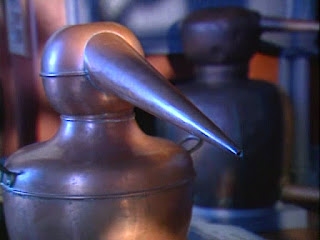
A collection of pioneer stills at the Oscar Getz Museum of Whiskey History in Bardstown, Kentucky.

Whiskey plays an outsize role in American history, largely because this continental nation had an active frontier for nearly 300 years and distilling was a typical pioneer industry. 

Whiskey enthusiasts tend to focus on a narrower window, the middle to late 18th century, a period that saw the beginning of bourbon and the birth of a nation, when the frontier was the land west of the Appalachian Mountains and east of the Ohio and Mississippi Rivers.

On the frontier, whiskey-making was an adjunct to farming. Almost everyone grew grain and distilled some of it into liquor, one way or another. If you didn't have a still somebody in the neighborhood did. Distilling was the only sensible thing to do with surplus grain. Wherever fruit was plentiful, it was fermented and distilled too. 

Distilled spirits were more than just another consumable. They were valuable. Where currency was scarce, as it typically was on the frontier, alcohol was a handy substitute. Fermented beverages such as beer, cider and wine were fine for drinking, but they were bulky and didn't keep. They weren't much good for high finance. Distill that beer down to about fifty percent alcohol-by-volume (100° proof), then you've got something.

Whiskey (or applejack) was like money in the bank. Everybody had a general idea how much a given quantity was worth, it was easy to divide, and always in demand. You could buy a nice farm with a barrel of whiskey. Abraham Lincoln's father did.

Businesspeople today talk about ‘liquidity.’ On the American frontier, ‘liquidity’ was literal. Alcohol was money. Before bourbon was bourbon it was a medium of exchange vital to the frontier economy.

On the frontier, most people were subsistence farmers. Communities were important but households had to be self-sufficient in food, clothing, and shelter. To live you needed a farm, and to farm you needed land. The constant need for more land inexorably pushed the frontier west. Since Roman times, governments have struggled to provide farmland for retired soldiers. The need for farmland following the French and Indian War (1754-1763) created friction between colonial administrations and the British government, leading to the American Revolution (1775-1783).

America’s original frontier had been the Atlantic coast, two fragile colonies of European immigrants in what would become Massachusetts and Virginia. Brewing and distilling began right away. Europeans brought with them barley, wheat, rye, oats and other Old World grains. The people who were already here introduced them to maize. 

The word ‘corn’ originally referred to any grain. Wheat and rye were types of 'corn.' This usage lives on today in terms like 'barleycorn.' When Europeans encountered maize for the first time, they called it ‘Indian corn.’ Eventually, English speakers in North America shortened that to simply ‘corn’ and the word’s original, broader meaning died out. 

Bourbon is whiskey made from maize, i.e., corn, a New World grain. That is what makes bourbon whiskey uniquely American. The first distilled beverages made in the colonies were not whiskey and the first whiskeys were not made from corn, at least not as the main ingredient. The first fermented beverages were made from fruit; mostly wild berries and grapes. Apples for cider were among the first cultivated fruit. When the first cereals the immigrants planted yielded their first harvests, food for animals and humans was the priority. Only when the fields yielded surpluses for those needs were cereals fermented and distilled. 

As trade got going among the New World colonies, the residue of Caribbean sugar production was shipped to New England where it was distilled into rum for local sale and export. Rum was America's first commercial distilled spirit. In the mid-18th century, bad mojo with Mother England created a clog in the molasses pipeline just as the growing colonial population began to spread into the interior. Only then did Americans start to make whiskey…spirit distilled from a fermented mash of grain…in earnest. 

At first they mostly used familiar cereals they brought from Europe: barley, wheat, rye, and oats, but by the 18th century they knew how to work with corn too. 

If a frontier grain farmer had a surplus of anything it was corn. Corn grew well and was very productive. It was excellent livestock feed, which is how most of it was used, but had limited applications as human food, to European tastes at least. Unlike barley and wheat, corn contains no gluten so it isn't much good for bread. Pioneers tended to eat corn only when they had nothing else, which often enough was the case.

So they turned their surplus corn into alcohol. That wasn’t easy either, nothing on the frontier was easy. Despite obstacles, corn became the go-to grain for distillation in the lands west of the Appalachian Mountains.

To make alcohol, you need a solution of sugar, water, and yeast. Since yeast is almost everywhere, you often don’t need to do anything except mix the sugar and water together. With fruit or any other direct sugar source, such as honey or molasses, starting fermentation is easy. Left alone, a sugar-and-water solution will ferment whether you want it to or not. 

It is harder with grain because you need an additional step. Cereals such as corn, barley, wheat and rye are mostly starch, so first you need to convert that starch into sugar. Seeds convert starch into sugar by producing certain enzymes. Any seed can produce the enzymes, but for our purposes the grain starches must be dissolved in water before the enzymes are introduced. Barley is favored because, when ground, its starches dissolve easily in warm water. Corn is tougher. To get its starches to dissolve takes hotter water, more time, and agitation. 

Corn beer never caught on as a drink, but it was (and is) a terrific base for distillation. Corn the hogs don't eat can be converted into something useful. 

The stage for bourbon was set. 


Tuesday, December 7, 2021

"That Night Was Scary." Pearl Harbor Remembered


Curtiss P-40 Warhawk

Eighty years ago today my father, Ken Cowdery, was at Schofield Barracks in Hawaii. He was a 21-year-old private in the United States Army, lined up for breakfast. Japanese bombers bound for Wheeler Field next door flew over his head, so close he could see the pilot's face.

Thirty years ago, for the 50th anniversary of Pearl Harbor, he wrote down some of his memories. Mostly they were stories we, his children, had been hearing for years. He passed in 2010, so it's nice to have them now in his own words.

The story of the morning attack I have posted on several of these anniversaries, most recently in 2018. This is what happened that evening.

In the immediate aftermath of the attack, chaos reigned on the island. Dad was company clerk, "like Radar on M.A.S.H.," he told us. His job that night was to monitor radio traffic, answer phones, and otherwise handle anything the officer in charge, Lt. Waid, needed him to do. Here is the rest of the story, in his own words.

___________________________

That night was scary, we could hear random bursts of small arms fire from time to time but had no inclination to investigate. The headquarters building was designated as a pick up spot for dependents to gather. The alert plan had this spelled out and busses were provided to haul them down to Honolulu to get them away from any legitimate target areas. While this mob of women and children was gathering downstairs a long burst of automatic weapon fire was heard nearby. The screaming did not subside for at least 10 minutes.

Fortunately, our people were pretty lousy shots at that point because we never heard of anyone being hit.

The worst case of trigger happiness occurred in our battalion. We had a 50 caliber machine gun set up on the roof of the barracks, it was on an anti-aircraft mount and protected by sandbags. Shortly after dark we heard a P-40 coming in low, (under certain wind conditions the normal landing path for Wheeler Field was directly over our barracks). As the plane approached the barracks we heard the 50 caliber open up. We didn't hear a crash so we figured everything was OK. A little while later we got a phone call, it was a Corporal from Wheeler Field asking us to inform the machine gunners that the plane they shot at was a P-40 and they should make sure what they're shooting at.

We had a field telephone line, not connected to the regular lines, over to the roof so we called them and told them to be more careful. They said that they were sorry, that it was an accident and it wouldn't happen again.

About a half hour later we again heard the familiar sound of a P-40 coming in on its landing path, and again we heard the POM, POM, POM of the 50 caliber. A few minutes later the phone rang again, this time it was a Sergeant, he was a bit more agitated and pointed out that we didn't have very many P-40s left and that our guys should quit trying to shoot them down. We called the gun crew again and chewed them out a bit, and they again said that they were sorry, that they were sure that it was a Jap and that they wouldn't do it again.

Sure enough, a bit later we again heard the familiar sound of a P-40 coming in and, unfortunately, the all too familiar sound of the 50 caliber. This time the call from Wheeler was very quick, very loud, (he wouldn't have had to use the telephone) and very angry. It was the pilot of the last plane. After several minutes of invective he said to tell those jerks up on the roof that he was informing all the other pilots still up in the air that if it happened again they should shoot back. 

Lt. Waid and I went up to the roof ourselves and tried to impress these guys with the gravity of what they were doing and the probable consequences.

They seemed to be duly impressed and promised that it would never happen again. Lt. Waid and I got off the roof quickly and went back to headquarters, in time to hear yet another P-40 start its landing approach. You guessed it, again the 50 caliber opened up.

Then we heard the P-40 pilot pour on the coal. We could hear him circle around and approach the landing path again, only this time we heard his 50 calibers firing.

After that, no more phone calls, no more shooting at friendly planes--those guys probably never fired another shot for the rest of the war.

Lt. Waid and I went back up to the roof the next morning. There were several spots in the roof that we were convinced were 50 caliber bullet holes, none real close to the sandbags but close enough to scare the bejabers out of those gunners.