The bourbon whiskey boom has been good for the economies of Kentucky and Tennessee, and now Alabama is getting a taste.
Brown-Forman Corporation has announced that it will invest about $60 million to establish a new cooperage in Lawrence County, Alabama, near
Decatur. The company is also about to open a sawmill in Stevenson. The new cooperage should come on line in 2014 and will have about 200 employees.
The location of the new cooperage is based on its proximity to Lynchburg, where Brown-Forman's Jack Daniel's is made. The sawmill project suggests that the new cooperage will receive at least some of its white oak from Alabama forests.
Brown-Forman's existing cooperage in Louisville, which currently supplies barrels for Jack Daniel's and other Brown-Forman products, primarily uses white oak grown in Missouri, Arkansas, Minnesota, and West Virginia. The wood is typically rough cut at sawmills close to the forests before being shipped to the cooperage.
All whiskey is aged in oak barrels but American whiskey is unique because it is always aged in new barrels. It is estimated that half or more of the flavor in a bourbon or rye comes directly from the wood, as does all of the whiskey's color. The new barrel maximizes extraction of tannin, vanilla, caramelized sugar, and other substances. A whiskey barrel is like a tea bag, as far as we're concerned, one and done.
If you want to make more whiskey, you have to make more barrels and build more aging warehouses. That's the only way to do it.
Used barrels typically go to Scotland, Ireland, and Canada.
Louisville has been operating at full capacity for several years and it has long been recognized that a second cooperage, when built, should logically be closer to Lynchburg. Brown-Forman is headquartered in Louisville, operates a whiskey distillery in nearby Shively, and another in Versailles, which is about 65 miles to the west. Lynchburg is 250 miles to the south. Decatur is much closer to Lynchburg, only about 80 miles away.
Brown-Forman is the only distilled spirits company in the world that manufactures its own barrels.
In addition to the barrel-making shop itself, a cooperage typically includes a large outdoor area where wood can be naturally seasoned by exposure to the elements. The Louisville Cooperage simply has no more room, either inside the building or on its grounds.
Up until a few years ago, Brown-Forman's cooperage also sold barrels to other bourbon and rye distillers, a practice they may resume after the Alabama facility comes on line. The only other large barrel-maker serving whiskey country is Independent Stave, which has cooperages in Lebanon, Kentucky, and Lebanon, Missouri. There are also several small cooperages that make whiskey barrels.
Whiskey-making and related industries such as cooperage are great examples of value-added manufacturing businesses that make products for both domestic and foreign consumption, and really can't move their operations out of the U.S. Cooperages are located where the trees and distilleries are, not where the cheapest workers are. U.S. laws, buoyed by international agreements, require bourbon and Tennessee whiskey to be made in the USA, and the strength of the Kentucky and Tennessee brands means whiskey-makers aren't about to move en mass to Vermont.
So drink American, it's good for the economy.
Saturday, June 16, 2012

Friday, June 15, 2012
The Bulleit Experience At Stitzel-Weller Distillery.

Several years ago at WhiskyFest Chicago, I was chatting with Chris Musumeci, then brand manager for Diageo's Bulleit Bourbon.
We talked about the growth and popularity of the brand. "At some point," he said, "Bulleit will need some kind of home place."
The distillery where it is made would be the natural home place but, as we both knew, Bulleit's products are contract distilled by non-Diageo distilleries.
My comment was, "Well, there's always Stitzel-Weller." Stitzel-Weller is the old Van Winkle family distillery. Built in 1933, it operated until 1992. It was the home of Old Fitzgerald, W. L. Weller, Rebel Yell, Cabin Still, and Old Rip Van Winkle wheated bourbons. The company now known as Diageo has owned it since 1987.
Last summer, it seemed as though they had taken my suggestion. "The Bulleit Experience at Stitzel-Weller Distillery" was announced with moderate fanfare. Industry people, including myself, were invited for previews. A few preview events were held. Mine was cancelled.
Another visit was scheduled and cancelled earlier this year. Two weeks ago, I finally got to peak behind the curtain.
The first pleasant surprise. There is a guard on the front gate again. In recent years, only the back gate has been used.
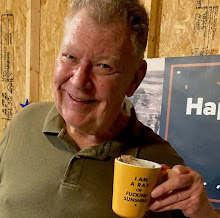
I was met by Tom Bulleit (left, in the photo) and Bobby Burke, who was introduced as the first tour guide. The focus of "The Bulleit Experience at Stitzel-Weller" is the old office building, whose design was based on Thomas Jefferson's home, Monticello. The effect of Southern gentility is enhanced by the large magnolia tree in front.
To the right, there is a small gazebo. To the left is the first row of black-painted, steel clad aging warehouses. On the long side of each warehouse there is a raised concrete walkway covered by a low roof, giving it the look of a covered porch. Upright whiskey barrels and rocking chairs complete the effect.
It is possible, therefore, to walk along the long side of each warehouse, protected from the elements, though still outside, and look into the open first floor windows, yet that's not part of the tour because of "insurance concerns."
Instead, details of the office building's architecture are pointed out. Don't get me wrong, I love that sort of thing. Inside there is a vestibule with some benches. The next door leads to a large room with exhibits that tell the history of the distillery, of the Bulleit brand, and of Kentucky whiskey-making in general. There are a couple of barrels marking production milestones and other artifacts drawn from the distillery's vast archives.
This central room has several doors. One leads to Tom Bulleit's office, which occupies a small portion of what was originally Pappy Van Winkle's vast office. It's a very handsome room.
Another door leads to another now-subdivided part of Pappy's old office, that is decorated like a library. This is where the tastings will take place. This space has a large window that provides a nice look at the grounds. Then there's the gift shop.
That's it.
I had a very nice time with Tom and Bobby. I was just meeting Bobby but I've known Tom for years and always enjoy his company. As I told them, I think people will be disappointed if they can’t see a little more of the distillery, in particular the inside of a warehouse and at least an outside look at the old still house. If going inside isn't possible, then at least include a walk of the grounds pointing these things out.
That's all there is anyway. No distilling or bottling is done there.
I also don't know where people are going to park. They have maybe ten spaces in front of the office building and no place for buses. You wouldn't want to sully the grounds by laying more asphalt. These may be some of the reasons why the place isn't open to the public. Tom and Bobby say they don't know when it will open. It's not up to them.
They did mention that recent road improvements make it easier to get there from Interstate 65, and the improved road takes the visitor past Papa John Stadium and Churchill Downs, where they might be going anyway.
For now, they're just using it to host journalists and trade customers.
They'd love to be on the official Kentucky Bourbon Trail and it would love to have them.
As they also point out, Stitzel-Weller is an active maturation facility. As such, it is overseen by John Lunn, who is best known as Master Distiller at George Dickel. He was recently promoted to Southern Hub Director for Diageo. The Southern Hub is comprised of the Dickel and Stitzel-Weller sites. As Director, Lunn oversees daily operations and is responsible for production, quality and safety.
Wednesday, June 13, 2012
New Larceny Bourbon Is A Mystery Times Two.
 These are the labels for a new bourbon from Heaven Hill. The story they tell is true. It was revealed in a book published in 1999. It is about John E. Fitzgerald, the man after whom the Old Fitzgerald brand was named.
The Old Fitzgerald brand was created by Charles Herbst, a pre-Prohibition wine and spirits wholesaler, based in Milwaukee, Wisconsin. It was made at a distillery Herbst owned near Frankfort, Kentucky, called Old Judge (now long gone).
When Herbst created the brand he made up a story to go with it, that Fitzgerald was a distiller in Frankfort who, starting in 1870, made a fine bourbon whiskey that he sold only to railroads, steamship lines, and private clubs.
It was all fiction, but Fitzgerald was a real person, a U.S. Treasury agent. Treasury agents in those days, and up until the early 1980s, controlled access to all whiskey warehouses, the better to ensure that all taxes were paid and all whiskey was made to government standards. This made the local 'government man' very powerful and there was little a distiller or distillery owner like Herbst could do if the agent assigned to his distillery helped himself to a taste now and then.
Fitzgerald had a reputation among the Herbst folks for being a particularly good judge of whiskey. The barrels that received most of his attention almost always turned out to be exemplary, and it became an inside joke to refer to a particularly good barrel of bourbon as 'a Fitzgerald.' The joke was immortalized when they chose John E. Fitzgerald as the fictional producer of a brand they called Old Fitzgerald.
No one knew the true story until author Sally Van Winkle Campbell and her historian consultant, Sam Thomas, uncovered it. Campbell is the granddaughter of Julian 'Pappy' Van Winkle, who acquired the Old Fitzgerald brand from Herbst during Prohibition.
The label above was discovered through a different kind of sleuthing. It didn't come from Heaven Hill, which owns the Fitzgerald brand today. Instead it was discovered by a COLA troller. COLA stands for "Certificate of Label Approval." All alcoholic beverage labels have to be submitted to the Treasury Department's Alcohol Tax and Trade Bureau (TTB) for approval, and when approved they become matters of public record and are posted on the TTB's web site.
COLA Trollers are enthusiasts who search the TTB web site for clues about new products. Label approval doesn't necessarily mean a product is imminent, or that it will be released at all, but they can be tantalizing, as this one is.
Tuesday, June 12, 2012
Kentucky Tavern Gets A Face Lift.

Kentucky Tavern has gotten a face lift. This is the new label.
Kentucky Tavern was the flagship brand of Glenmore Distillery, which had its offices in Louisville, with the distillery itself in Owensboro.
Glenmore also owned the Yellowstone brand, and its distillery in Shively (a Louisville suburb). Yellowstone was the bigger brand, but it was like Jack Daniel's is to Brown-Forman's founding brand, Old Forester. Kentucky Tavern - known as KT - was Glenmore's flagship.
Glenmore was the Thompson family's distillery. The Thompsons, Browns and Van Winkles were Louisville's leading distilling families of the post-Prohibition era. The Van Winkles sold Stitzel-Weller in 1972. 'Buddy' Thompson sold Glenmore to what became Diageo in 1991.
KT got beat up and bounced around after that, at various points becoming "Kentucky Whiskey," and even a blend.
Now owned by Sazerac and made at the Barton 1792 Distillery in Bardstown, it is Kentucky Straight Bourbon Whiskey once again.
The KT brand was somehow linked to an actual Louisville bar of the same name, frequented by Louisville downtown business types because it was conveniently located between downtown and their northeast side homes. The bar's heyday was the 1950s, so one assumes the bar was named after the whiskey, which began in the early 20th century.
The names may even have been a coincidence, but came to be linked together in the minds of many. Both were called KT.
In the 1980s, when Glenmore was still independent and looked like it might be one of the survivors of bourbon's collapse, a new KT's was erected on or near the original location near Louisville's Cherokee Park. Good bar. Good sandwiches. No connection to the distillery or the original bar, just a tribute, and still in a good location.
Sunday, June 10, 2012
The Bourbon Boom Is Good For Producers, But Is It Good For Us?
American whiskey has never been more popular than it is today and the industry is healthier than at any time in the last 50 years or so. Sales are up domestically and internationally. Every year, Kentucky sets new tourism records. Micro-distilleries are appearing throughout the land.
The Bourbon Boom is surely good for the companies that make and sell bourbon, but is it good for us, the folks who merely buy and drink the stuff?
We examine that question in the new issue of The Bourbon Country Reader, which dropped Friday. You really should subscribe. The June, 2012 issue of The Bourbon Country Reader is Volume 14, Number 4. In it, we also offer some glassware tips and launch a new project designed to unlock the mystery of bourbons past.
The Bourbon Country Reader is produced and delivered the old-fashioned way; ink on paper, in an envelope, delivered personally to your home or office by a uniformed representative of the United States government. Subscriptions to The Bourbon Country Reader are $20/year for U.S. addresses, $24.50 for Canada, and $28.50 for everybody else. It is published six times a year. Well, maybe not (we missed April), but your subscription always includes six issues.
Click here to subscribe with PayPal or any major credit card. Click here for more information. Click here for a free sample issue (in PDF format). Click here to open or download the free PDF document, "The Bourbon Country Reader Issue Contents in Chronological Order." (It's like an index.)
The Bourbon Boom is surely good for the companies that make and sell bourbon, but is it good for us, the folks who merely buy and drink the stuff?
We examine that question in the new issue of The Bourbon Country Reader, which dropped Friday. You really should subscribe. The June, 2012 issue of The Bourbon Country Reader is Volume 14, Number 4. In it, we also offer some glassware tips and launch a new project designed to unlock the mystery of bourbons past.
The Bourbon Country Reader is produced and delivered the old-fashioned way; ink on paper, in an envelope, delivered personally to your home or office by a uniformed representative of the United States government. Subscriptions to The Bourbon Country Reader are $20/year for U.S. addresses, $24.50 for Canada, and $28.50 for everybody else. It is published six times a year. Well, maybe not (we missed April), but your subscription always includes six issues.
Click here to subscribe with PayPal or any major credit card. Click here for more information. Click here for a free sample issue (in PDF format). Click here to open or download the free PDF document, "The Bourbon Country Reader Issue Contents in Chronological Order." (It's like an index.)
Tuesday, June 5, 2012
New Bourbon Trail Souvenirs Unveiled.
The Kentucky Bourbon Trail tour is commemorating its 13th birthday with the unveiling of a new online store featuring clothing, barware, specialty items and more.
"With the growth in popularity of the Kentucky Bourbon Trail adventure, our visitors have been clamoring for more souvenirs to remember their experiences," said Adam Johnson, Director of the Kentucky Bourbon Trail tour.
Kentucky Bourbon Trail merchandise also can be found in select stores and attractions throughout the Commonwealth. Items include barrel staves and barrel heads, rocks glasses, and apparel.
One particular item, the official Kentucky Bourbon Trail leather Passport holder, is ideal for anyone getting ready to embark on a Kentucky Bourbon Trail quest, Johnson said. It can be personalized with the recipient’s name and comes with a Passport, ready for stamps.
"We get dozens of phone calls from people planning a surprise visit to the legendary Kentucky Bourbon Trail distilleries for their friend, spouse or loved one," Johnson said. "And they all want something to put in a box besides our brochure and map. The new personalized Passport holder will become the way to let someone know that they’re about to start the tour of a lifetime and learn about the rich history and proud heritage of America’s only native spirit, Kentucky Bourbon."
The official Kentucky Bourbon Trail includes six distilleries operated by members of the Kentucky Distillers' Association. They are Four Roses, Heaven Hill, Jim Beam, Maker’s Mark, Wild Turkey and Woodford Reserve.
"With the growth in popularity of the Kentucky Bourbon Trail adventure, our visitors have been clamoring for more souvenirs to remember their experiences," said Adam Johnson, Director of the Kentucky Bourbon Trail tour.
Kentucky Bourbon Trail merchandise also can be found in select stores and attractions throughout the Commonwealth. Items include barrel staves and barrel heads, rocks glasses, and apparel.
One particular item, the official Kentucky Bourbon Trail leather Passport holder, is ideal for anyone getting ready to embark on a Kentucky Bourbon Trail quest, Johnson said. It can be personalized with the recipient’s name and comes with a Passport, ready for stamps.
"We get dozens of phone calls from people planning a surprise visit to the legendary Kentucky Bourbon Trail distilleries for their friend, spouse or loved one," Johnson said. "And they all want something to put in a box besides our brochure and map. The new personalized Passport holder will become the way to let someone know that they’re about to start the tour of a lifetime and learn about the rich history and proud heritage of America’s only native spirit, Kentucky Bourbon."
The official Kentucky Bourbon Trail includes six distilleries operated by members of the Kentucky Distillers' Association. They are Four Roses, Heaven Hill, Jim Beam, Maker’s Mark, Wild Turkey and Woodford Reserve.
Monday, June 4, 2012
Frivolous Fungus Suit Endangers Kentucky Prosperity
Kentucky is abuzz about a lawsuit filed in federal court last week. It alleges that vapors emitted by aging whiskey carry a fungus that produces persistent black spots on homes and cars.
This is nothing new in Kentucky, or anywhere that distilled spirits are aged. The Louisville Courier-Journal has a well-reported story about it here.
The fungus is well known and generally regarded as harmless, if a bit of a nuisance. It can be removed with a little soap and water. Typically, all a distillery neighbor has to do is ask and the distillery will send a cleaning crew at no charge.
It is extremely doubtful that any complainant bought their house before the accused distillery was built. The fungus was likely on their house when they bought it. It's nothing new, although it may have gotten a little worse lately because more bourbon is being made. This appears mainly to be a case of a lawyer seeing an opportunity to make some money. The allegations of serious harm are dubious and the proposed solutions are much more destructive.
For instance, one of the reasons three of the top five domestic brandies are aged and bottled in Kentucky is because California is forcing distillers there to wrap their barrels in plastic or otherwise prevent the release of ethanol, which also prevents the spirit from aging properly.
The suit alleges that the fungus is borne by the alcohol vapors. This is likely untrue. Much more likely is that the spores are everywhere in the environment, just waiting for the right combination of water and ethanol.
Kentucky is enjoying significant economic development benefit from the present bourbon boom. In addition to increased bourbon production, there is significant ancillary business such as Beam's decision to move DeKuyper Liqueur production to Kentucky and Campari's decision to also bottle Skyy Vodka in Kentucky when it returns Wild Turkey bottling to the Commonwealth next year.
The Kentucky House, primarily because of representatives from dry counties, is constantly in danger of killing the goose that lays the golden egg. Kentucky doesn't have that many booming industries, it needs to play nice with the ones it has. Kentucky readers of this blog are advised to contact your legislators. While this is a court case and not proposed legislation, it never hurts to get a jump on these things. Perhaps something can be done proactively to prevent these nuisance suits from being brought in the future.
If the case gets to trial, it will be in District Court, but if it gets to the Sixth Circuit on appeal, the bourbon-makers will have a sympathetic ear. The senior judge there is Boyce F. Martin, Jr., who demonstrated in the recent case of Maker's Mark v. Diageo that he knows his way around bourbon.
Subscribe to:
Posts (Atom)