
 |
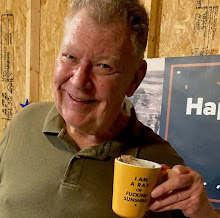
| Fred and Freddie Noe at the Beam Distillery in Clermont, Kentucky. |
As reported today by the Kentucky Herald-Leader, Louisville Business First, and other sources, Suntory Global Spirits, parent company of Jim Beam, has issued the following statement:
“We are always assessing production levels to best meet consumer demand and recently met with our team to discuss our volumes for 2026. We’ve shared with our teams that while we will continue to distill at our (Fred B. Noe) craft distillery in Clermont and at our larger Booker Noe distillery in Boston, we plan to pause distillation at our main distillery on the James B. Beam campus for 2026 while we take the opportunity to invest in site enhancements. Our visitor center at the James B. Beam campus remains open so visitors can have the full James B. Beam experience and join us for a meal at The Kitchen Table.”
Beam has bottling lines at Clermont that will continue to operate, supporting the Clermont maturation warehouse complex. In addition to Clermont, Suntory has bottling lines at the former Old Grand-Dad Distillery in Frankfort.
No announcement has been made about layoffs, but a law requires large employers like Beam to notify government officials if a layoff will affect more than 50 positions. No such notice has been given.
Because the distilling part of the operation is largely automated, it’s likely the number of affected positions will be small. Affected employees might be shifted into other positions or transferred to another facility.
Not in the article, but pointed out to me by a former Beam insider, is that the distilling infrastructure at Clermont is about 50 years old. Booker Noe/Boston is more modern and has more than enough capacity to meet anticipated needs in the near term, which certainly means the entirety of 2026. It is likely Clermont will either receive a major overhaul or be retired.
Although it is smaller than Booker Noe/Boston, Clermont is considered Beam’s main plant, in part because of the now very important tourism component, and because historically it is where Jim Beam, his brother, and their sons resumed distilling after Prohibition.
The Fred B. Noe Craft Distillery, which opened in 2021, is also on the Clermont campus. It has an annual capacity of about 1.2 million gallons. That’s comparable to Willet, Rabbit Hole, New Riff, Sagamore, and several others, a not insignificant volume. It is state-of-the-art.
This behavior looks a lot like what happened in the late 70s, early 80s, with one key difference. That time, people started to skip seasons or shut down plants entirely after nearly a decade of not adjusting to a changing market. In this case, the reaction/response is only about a year late. In that sense, all this bad news is good because it says the industry is doing what it should to prevent a glut. So far, the responses we’ve seen from Suntory and others have been timely and proportional.
We're getting our first glimpse of the "new normal," which is really the old normal, but at a much higher level.
For close to 20 years, all the major American whiskey distilleries have produced at or near capacity. It shouldn't be like that. Let's say an ideal level is 75 percent capacity. That way, you always have sufficient capacity to ramp up when you need a little more production. That's the efficient way to run a distillery.
A distillery is either on or off. All major producers use continuous stills, which are designed to run continuously, up to and including 24 hours a day. They must be shut down periodically only for cleaning and other maintenance. Consequently, the way you make more or less is in how many days you distill.
Historically, extended shutdowns that are used to adjust production occur between seasons. For distilleries, the year has two seasons, identified as spring and fall, but spring is the first six months of the year, and fall is the rest. That means production shutdowns usually, and deliberately, occur during the coldest part of winter and the hottest part of summer.
Ideally, you will distill for at least some number of months in each season. Shutting down for a whole season, let alone a whole year, is a big deal, but it’s mitigated in this case because Beam has two distilleries, with the same DSP number, less than ten miles apart, making the same products, so they’re still going to be make whiskey every season, just not at that distillery.
Suntory also owns the Maker’s Mark Distillery in Loretto, Kentucky, which is unaffected.


No comments:
Post a Comment