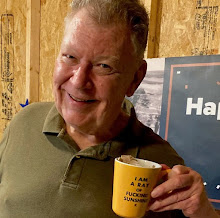
Do you recall this post from last year, about the small barrels experiment at Buffalo Trace (BT)? It created quite a sensation. Well, it's now a book. A very small book (like the barrels) but also a very inexpensive one, just 99 cents on Kindle.
I have been looking at Kindle as a way to make some of the material I write for my newsletter, The Bourbon Country Reader, available to a wider audience. So this is, in part, an experiment.
By the way, you don't need a Kindle to read a Kindle book. You can download a free reader for PCs and other devices, or you can just read them using your web browser.
In addition to the small barrels article, the book includes a new piece about some of the reaction, plus a review of a couple of specific whiskeys aged in little barrels. There's also a piece originally posted here in December, 2010.
The recent post received a lot of comments, most of them from people who only (and in some cases, barely) read the post, not the actual article. You can find more people taking me to task over on the ADI Forums. Plenty of people are prepared to ream me for the headline alone. This way they can at least read the article first.
One familiar refrain is that of course whiskey aged in small barrels for five years is bad, you should never age whiskey in a small barrel for that long, yet I defy anyone to show me where anyone made such a statement before I started to publicize the BT experiment.
Tuesday, January 17, 2012
Monday, January 16, 2012
Your Vote, Your Bourbon.
It is an indication of how mainstream American whiskey has become in recent years that novelty products are now being made using whiskey as their platform.
This is a new/old trend, as there were many novelty bourbons 50 years ago, when the Republican Elephant in the picture above was made by Jim Beam for the 1960 presidential election. It had, of course, an equine counterpart. Beam continued the series through several more presidential election cycles, with new designs each time.
The pictured decanter held Beam straight bourbon at 43% ABV, aged 100 months (8.3 years).
The contemporary version is Heaven Hill's new Red State and Blue State bourbons, which should be in stores now. The whiskey is Heaven Hill straight bourbon (i.e., Evan Williams) at 40% ABV, with no age statement. The price should be about $15.
The idea, of course, is to express your political preference according to which one you buy. Another suggestion is that you buy both for a party and see which one wins among your guests. No one pretends it's anything other than a fun way to sell a little more bourbon.
If you go to either product's Facebook page and 'like' it, a donation will be made to the USO.
The irony of both bottles containing the exact same whiskey is probably unintended.
Sunday, January 15, 2012
Children Welcome!
Most alcohol-related sites on the web have an age gate. It's all honor system, but you must at least claim you are of legal drinking age to get in.
There's a good reason for this. The purpose of those sites is to persuade visitors to buy a certain alcohol product. All alcohol producers pledge not to market their products to underage persons, and contrary to the calumnies of the Neo-Prohibitionists, the vast majority of alcohol producers honor that pledge in good faith. Hence the age gates.
Some booze bloggers also label their sites 'for adults only.' That's their prerogative, but The Chuck Cowdery Blog has a different attitude.
You may be too young to drink alcoholic beverages but you're never to young to learn.
What you read here will be factual, honest, and suitable for persons of all ages. Childhood is not a permanent condition and most of it is spent preparing for adulthood. If you are underage, it is for many reasons in your best interest to obey the law, but by all means drink deeply of the cup of knowledge, and do so early and often.
Young people should be encouraged to eschew alcohol until they reach legal drinking age, but you won't accomplish that by pretending alcohol doesn't exist. If all they get is the ham-handed and dishonest anti-alcohol messages contained in most youth alcohol awareness programs, that alone may drive them prematurely to imbibe.
So don't drink, kids. And say no to drugs. And you might want to watch your caffeine and sugar intake too. But by all means, read.
And if this post, and especially the picture, infuriates some Neo-Prohibitionists, that's a bonus.
Saturday, January 14, 2012
BT's Single Oak Project Suffers From 'Holy Grail' Tag.
On his Sour Mash Manifesto blog this past Wednesday, Jason Pyle worried that his whiskey geek card might be taken away because he can't get behind the Buffalo Trace (BT) Single Oak Bourbon Project.
Jason's whiskey cred is secure. He may be overly fond of white and under-aged craft whiskeys, but on the Single Oak thing he's not wrong.
Reading over the piece and its comments, it becomes clear that the problem isn't the Single Oak Project per se, it is the whole 'search for the Holy Grail' overlay, in which BT says Single Oak is part of its quest to make the perfect bourbon.
Holy Grail has become a double-edged sword for BT. The theme is a winner with the general press. It piques their interest and that allows BT to reach a wider audience. But it turns off the whiskey geek community because it glorifies something we reject. We're not in this to find one whiskey to drink for the rest of our lives. We want to have as many good but different whiskey experiences as possible. Sampling the Single Oak bourbons is a good and different whiskey experience, one Jason and many others will enjoy more if they just forget the 'Holy Grail' nonsense.
BT is okay with that. They have always said 'Holy Grail' is more about a commitment to continuous quality improvement than it is about actually making the ultimate bourbon. Taken as a metaphor, it's not nearly so irritating and distracting. It's also another way BT breaks with conventional whiskey wisdom, as most producers like to claim they achieved perfection a century ago and haven't changed a thing since.
Which is the higher pile of hubris is up to each of us to decide for ourselves, but there is genuine appeal in the idea that the best is yet to come.
Friday, January 13, 2012
Meet Your Chicago Distillers, February 8.
There are now three micro-distilleries in the Chicago area and you can sample their wares on Wednesday, February 8, from 7 PM to 10 PM, at Jerry's in Wicker Park (1938 W. Division).
Participating are Koval (Ravenswood), Few Spirits (Evanston), and North Shore Distillery (Lake Bluff).
Leanne Strickler, of North Shore, is the guest bartender.
Your $10 entry includes one specialty cocktail, plus samples from the distillers.
One of the most exciting things about the micro-distillery phenomenon is how these craft spirits-makers relate to their local communities. They develop very loyal and ardent fan bases and this is an easy way to get a taste of that, quite literally, especially if you live in or near Chicago's Wicker Park neighborhood.
Wednesday, January 11, 2012
DISCUS Applauds Bloomberg's "Commitment to Hospitality Jobs."
Say what you will about lobbyists. When they lobby for a cause you support, you hope they will be good at their job. The Distilled Spirits Council of the United States (DISCUS) is good at its job.
The first rule of issue advocacy is framing. Define the issue in the way most favorable to your position. That's why the headline on the press release is: "Distilled Spirits Council Applauds Mayor Bloomberg’s Commitment to New York City Hospitality Jobs."
That's not how the story started out.
Overnight, the New York Post broke a story under the headline, "Mayor's plan to limit booze sales." The lead went like this: "Party pooper! First, Mayor Bloomberg went after smoking in public places. Then trans-fats, salt and sugary drinks. Now Bloomberg — known for sipping fine wine and downing a cold beer from time to time — wants to crack down on alcohol sales to curb excessive drinking, according to a provocative planning document obtained by The Post."
The story was quickly picked up by bloggers, all too eager to condemn Bloomberg as First Nanny.
Small problem, though. It wasn't true.
The proposal to slash the number of establishments in the city that sell booze came from the city's health department, in a planning document that hadn't been fully vetted yet. Someone leaked it to The Post and they rushed it into print, assuming Bloomberg himself endorsed the plan.
He didn't.
Within hours of The Post's story, Bloomberg nixed the proposal (through spokesman Stu Loeser) and only then did DISCUS let its short press release fly.
"The Distilled Spirits Council applauds Mayor Bloomberg for nixing the New York City Health Department proposal to reduce alcohol outlets, and for understanding that population-based approaches to reduce alcohol abuse are ineffective. The Mayor clearly realizes that forcing thousands of restaurant workers and bartenders into the unemployment line is no way to improve community health.
"Repeated studies have shown that population-based approaches, such as advertising restrictions and a reduction in retail outlets, do little to reduce alcohol abuse and will only impact moderate drinkers and the employees of the hospitality industry."
That last sentence is worth committing to memory, for use the next time some politician or activist goes on a tear about restricting the number of retail licenses, or banning or restricting alcohol marketing. (Remember the Four Loko nonsense?) Those are phony solutions. They do nothing to discourage alcohol abuse and they hurt small businesses and the people they employ. They also inconvenience the vast majority of alcohol consumers who do so responsibly.
There is a constituency for that sort of thing. It is the anti-alcohol movement -- Neo-Prohibitionists, New Drys, whatever you want to call them. Their true goal is to give National Prohibition another go, but they know better than to admit that outright. Don't be fooled.
The Post, of course, in all its shameless majesty, is now crowing about how it broke the story. It neglects to mention that it grossly mis-reported the story. I'm sure no one is surprised by The Post's crappy journalism. Stay classy, NYP.
Wednesday, January 4, 2012
Next Time, Take Whiskey.
It is considered good form to take a host/hostess gift whenever you attend a party in a private home. Obviously, there are exceptions, but even when it's not really expected it is almost always appreciated.
A bottle of wine is the most common gift. Many people misunderstand this tradition and think the gift is necessarily supposed to be used at that evening's festivities. It can be but it doesn't have to be. It is a gift and as soon as you hand it to your host/hostess it is their property and theirs to use as they see fit.
Don't be offended if they put it away and don't open it. Don't assume that means they don't like it. It may mean they like it very much and don't want to share it. That's their business and you should be okay with whatever they do. That's the etiquette rule. You can look it up.
Obviously, if it's a BYOB party or you have previously agreed to provide wine for the event, that's a different story, but a pure host/hostess gift is just that, a gift.
And it doesn't have to be wine. I've used flowers successfully. Candy or some other treat can be good, though it shouldn't be something perishable that seems to demand immediate consumption. Again, it's a gift. Your interest in it expires the moment you hand it over.
If wine is good, why not whiskey? I just heard from a correspondent who bought a case of Rittenhouse Rye Bottled-In-Bond (BIB) to make that his standard host/hostess gift. Buying a case brings the per-bottle price down to about $20. Rit is a nice choice because it's very good whiskey at any price, and happens to be a good value. In some markets, it's even a few bucks less. That price is here in Chicago.
Rittenhouse Rye BIB has been in short supply lately, but the drought seems to be over. I was in the Lincoln Park Binny's tonight and they had a floor stacking of about 50 cases, priced at $22.99 for the individual 750 ml bottle (less for a 12-bottle case).
Rittenhouse Rye is a straight rye whiskey. The BIB is 50% ABV. There is a 40% ABV version too, but that one is not widely distributed. The BIB is very popular with bars and cocktail enthusiasts. It is a Heaven Hill brand but the current product was made for them by Brown-Forman, before Heaven Hill increased capacity at its Louisville distillery. Now their rye is all made there, but it will be a few more years before that whiskey reaches market.
Subscribe to:
Posts (Atom)