Wednesday, February 15, 2023

Scotch Guys Think Bourbon Guys Are Screwing with 'Their' Barrels


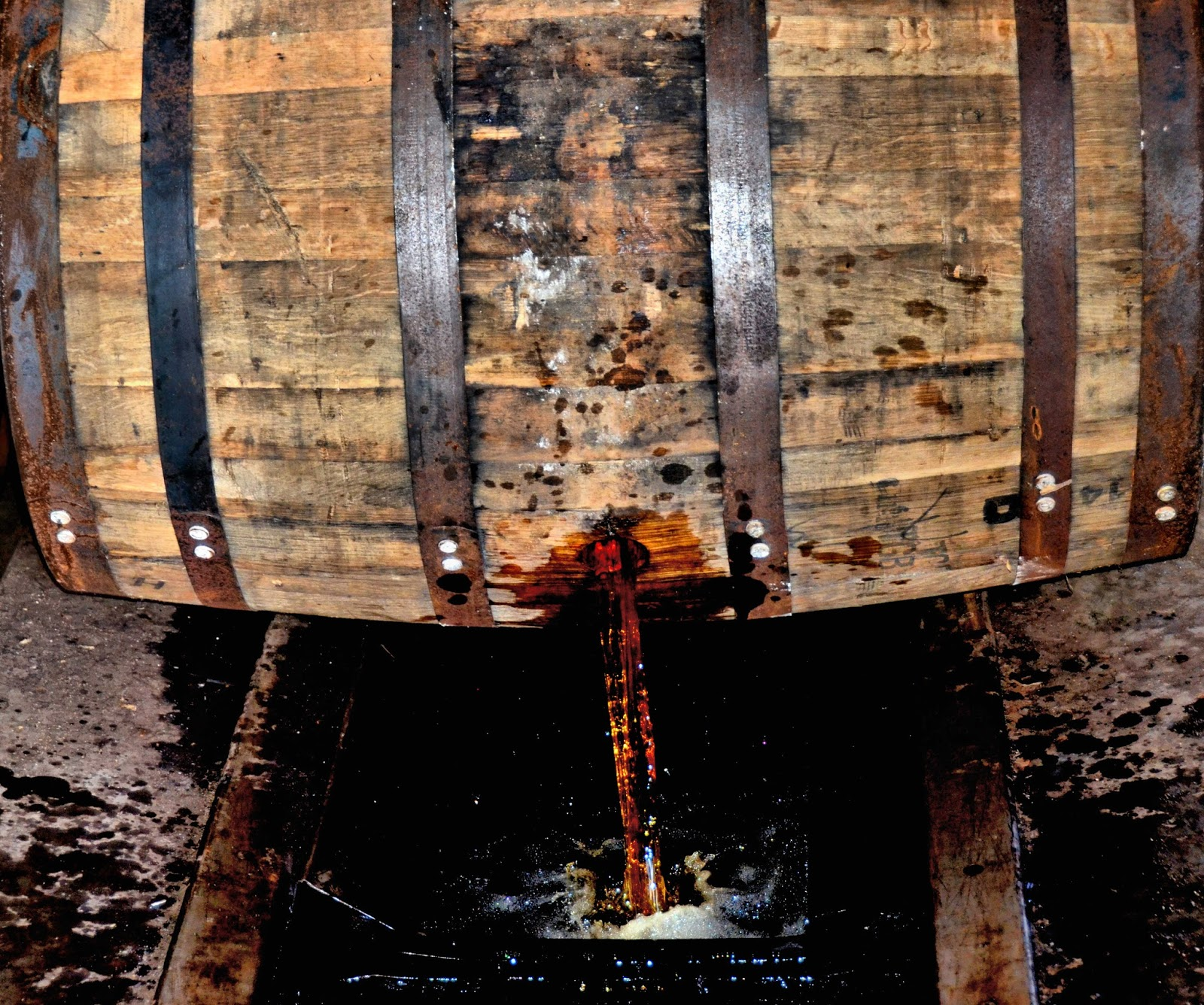
Dumping a bourbon barrel. But is it really empty?
The headline seems innocuous enough: "Why more bourbon distillers are rinsing their used barrels." In her article in Whisky Magazine, Susannah Skiver Barton explains how, since bourbon must be aged in new barrels, producers of other kinds of barrel-aged products, such as scotch whisky, reuse them.

But then the trouble starts. "In the last decade," writes Barton, "the American whiskey industry has begun adopting a dumping technique that changes the way the barrel behaves when it goes on to its next life. After emptying barrels of mature whiskey, distillers are filling a few gallons of water into the wood, 'rinsing' it of any excess spirit (sometimes using pressure or jets), and using that liquid in the proofing process. It’s a cost saving for them – they get more alcohol per barrel – but potentially disastrous for Scotch, because water-rinsed barrels mature single malt very differently from their standard counterparts."

Several scotch-makers then go on to bemoan the misbehavior of those tricksey Americans.

Do scotch-makers have a legitimate gripe, or are they being disingenuous?

First, this term 'rinsing.' Bourbon producers have always rinsed barrels. When the newly dumped barrel has stopped draining, a worker with a hose squirts some water into it, rolls it over again, and dumps the water out. This is mostly to rinse out loose sediment, but it gets some whiskey too.

That's not what the article is about. They are using 'rinsing' as a euphemism to describe something else entirely, and it is nothing new. Jack Daniel's started to do it 16 years ago. Here is how I described the process in The Bourbon Country Reader in 2007, after I watched them do it.

"When whiskey barrels are dumped, they never give up 100 percent of their contents. A small amount of whiskey stays behind, trapped in the wood.

"At a new facility near a cluster of warehouses, several miles from the tourist sites, Jack Daniel’s is doing something no other distillery has tried to recapture some of that lost product.

"After dumping, each empty barrel is sent to this building (a big, feature-less, steel-clad industrial structure) where it is loaded with about 20 gallons of water, a level which, with the barrel standing on end, doesn’t quite reach the now-open bunghole.

"After they receive their water, these barrels are placed on pallets, nine at a time, and stacked up about ten high in the warehouse portion of the building, where they sit for three to four weeks.

"The water is then dumped out and used to dilute barrel proof whiskey down to its bottling proof.

"There was a previous system, in which the barrels were merely rinsed. This new system produces five times as much additional product, as measured by its alcohol content."

Jim Beam started to do something similar in 2011. They passed it on to Maker's Mark in 2013. Their process uses heat and agitation, similar to a practice beloved by youngsters throughout whiskey country known as 'sweating' a barrel. Kids would ‘liberate’ a freshly-dumped barrel from one of the local distilleries, put a few gallons of water in it, plug up the bung hole, and roll the barrel around in the hot sun until they got bored. The resulting liquid usually contained enough alcohol to deliver a light buzz.

Unless one can press a herd of thirsty teenagers into service, the process requires a dedicated facility. It's not cheap. That's why the practice isn't universal. If a scotch-maker is buying used bourbon barrels without determining how they were processed, whose fault is that?


Thursday, February 2, 2023

America Should Reconsider the 3-Tier System


Image courtesy National Alcohol Beverage Control Association (NABCA)

As American laws go, the 21st Amendment to the Constitution is stunningly brief, not even 100 words, most of them boilerplate. 

The first section repeals the 18th Amendment (i.e., Prohibition). The third sets out the window for ratification: seven years. It's the second section that concerns us. What it says in 31 words can be said in eight: states may regulate beverage alcohol however they choose.

Each state does it differently, but a common feature is the three-tier distribution system. The three tiers are producers, wholesalers (aka, distributors), and retailers. 'Retailers' includes both off-premise (bars and restaurants) and on-premise (stores that sell beverage alcohol by the bottle).

The issue with the three-tier system is not whether or not it provides value, it is whether or not requiring the 3-step process is justified. If I can streamline my business by eliminating a step, what public policy interest prevents me?

Before Prohibition, 'tied houses' were a common feature of the retail landscape. A 'tied house' was a retail outlet (a bar, typically) owned by a producer. It was widely believed that when producers controlled retailers in this way, consumers and communities suffered because all the far-away producer cared about was increasing sales and profits. If lives and even whole communities were destroyed, so what? 

More importantly, what could the affected community do about it?

After Prohibition, it was believed that preventing the tied house and keeping retailers as far from producers as possible would prevent most abuses. The wholesaler would insulate the retailer and retail customers from the depredations of rapacious producers. The wholesaler would be an in-state company with seizable in-state assets, which would keep wholesalers on-side.

Most states also separated the two types of retailers. Bars can't sell bottles and bottle shops can't sell drinks. Both types have to buy from wholesalers. They can't buy directly from producers, nor each other. In many states, chain retailers are prohibited even from transferring merchandise from one store location to another. 

Today, because so much has changed, the mandatory wholesale tier can seem like a vestigial organ. Big producers would love to sell directly to large chain retailers. Brown-Forman would love to distribute Jack Daniel's to Walmart through Walmart's distribution system, not through 50 different distributor locations in 50 states. They'd love to do it with Chili's, Applebee's, Hilton, and Marriott too. 

Big producers do sell directly to those national customers, and even many smaller local and regional customers, they just run the paperwork through distributors, who also do the physical distribution. Is there a genuine public policy justification for requiring that, despite the obvious inefficiency? 

One reason the present system seems pointlessly wasteful is how easily rules are circumvented. 'No cross ownership' is a joke. The businesses have to look separate on paper, but distributor/producer cross-ownership is common in fact. Distributors as in-state businesses? Also a joke. Most distributors are national or nearly so, they're just separately incorporated in each state where they do business. (For more about this click here.)

Does it make sense that a distillery gift shop must buy its own distillery's products through a distributor? 

The system has changed little since 1933. In the last decade or so, a few states have changed their laws to allow craft producers to do many things large producers cannot. Otherwise, the laws have been virtually impossible to change. That's because distributors and government (both the elected part and the bureaucracy) have a vested interest in the status quo. Small retailers do too.

Wholesalers in this system are so coddled that in some states it is virtually impossible for a producer to fire their distributor and sign-up with a different one. 

Because each state's laws are unique, sometimes in subtle ways, regulatory compliance is maddeningly difficult and wastefully expensive.

Producers of all sizes and large retailers would like to see the distributor made optional, not mandatory, or modified in some way to reduce its wastefulness.

The interests of consumers and of the public at large are supposed to be paramount to regulators. A more efficient system would surely benefit consumers in terms of lower prices and greater convenience. More liberal laws in general would liberate the creativity of all industry participants to better fulfill consumer wants and needs. Policies intended to limit harms caused by alcohol abuse could be focused directly on the problems instead of a very broad proxy for them.

In defense, distributors will trot out the vague claim that they protect children from the harm of underage drinking, but precisely how the 3-tier system is uniquely effective at preventing underage drinking is never explained.

C. Jarrett Dieterle, a Resident Senior Fellow, Competition Policy, at R Street Institute, specializes in alcohol policy. He writes often and well on this and other matters.

America's liquor laws, directed as they are at 19th century problems, badly need a 21st century upgrade.


Saturday, January 28, 2023

Guess What? None of It Is Whiskey


A mini-bottle of Fireball Cinnamon Whisky (L) and a mini-bottle of Fireball Cinnamon Flavored Malt Beverage (R)

"There's no whiskey in mini bottles of Fireball, so customers are suing for fraud," reads the headline on the website for National Public Radio. Yes, even NPR is weighing in on the class action lawsuit involving Sazerac's treasured money tree known as Fireball

NPR explains it like this: "Consumers are suing Sazerac Company, Inc., the makers of Fireball whiskey, for fraud and misrepresentation, as the mini bottles of the alcoholic beverage don't actually contain whiskey. The smaller bottles, named Fireball Cinnamon, are made from a blend of malt beverage and wine, while the whiskey-based products are called Fireball Cinnamon Whisky, according to the company website."

These lawsuits happen from time to time, with similar fact patterns. To say "consumers are suing" is a euphemism for "lawyers see an opportunity to make some money." These suits typically fail if the producer has complied with all legal requirements. 

The wrinkle in this case seems to be use of the term 'whisky flavor' in the description of the non-whisky version.

These cases generate a lot of publicity and Fireball is a product for which there is no such thing as bad publicity.

Is the consumer misled? Plaintiffs argue that consumers intend to buy whiskey. Do they? Or is ethanol what they intend to buy and ingest? Both versions contain ethanol. Both get you buzzed.

And neither is whiskey.

The distilled spirit product gets its alcohol from a base of Canadian whisky, which by style has very mild whiskey flavor. Cover that up with sugar, cinnamon, and other added flavors, and you're not drinking whiskey.

Clearly, many people like these products. There always is a market for sweet drinks. Many so-called 'flavored whiskeys' are liqueurs with vodka (i.e., neutral spirit) as a base. Even products like Jack Daniel's Honey probably contain more vodka (i.e., grain neutral spirit) than they do whiskey. If you see the word 'liqueur' in the product description, that's a tip-off. (Another Fireball variation had liqueur as a base.) Even if a liqueur contains whiskey, it is likely getting most of its alcohol from neutral spirit. Fireball is 'whisky with natural cinnamon flavor,' but its Canadian whisky base is nearly flavorless. Most of the spirit in Canadian whisky is distilled almost to neutrality and aged in used cooperage. 

There are many fine Canadian whiskies on the market, whiskies that taste like whisky. But because it is so mild and doesn't cost much more to make than vodka, bulk Canadian whisky is often the base for flavored whiskey products. Sazerac also exploits the designation 'spirit whiskey,' another nearly-neutral distillate it uses as the base for Southern Comfort, another sugary concoction.

These products are cheap to make. Most of the expense is in marketing. Sazerac has been spending billions on acquisitions and expansion. The success of Fireball is funding a lot of it.

What does whiskey have to do with it? Nothing. Drink these products if you want, really. It's your mouth. Just don't tell yourself you're drinking whiskey. It's kind of great that whiskey is so popular right now that everybody wants to slap that word 'whiskey' on their label. Kind of great, kind of not.

But drink them if you want, it's fine. It just has nothing whatsoever to do with with whiskey. Whiskey should taste like whiskey, not like peanut butter. Whatever Fireball and its kin may or may not contain, they do not taste like whiskey. The legal definition of 'whisky' requires that "the distillate possesses the taste, aroma, and characteristics generally attributed to whisky." 

In these products, whiskey contributes nothing to the drink except ethanol. Ethanol is made by fermenting sugary water, which can come from cereal grains like corn and barley, fruit like grapes and apples, the sap of maple trees, the honey of bees, or squeezings of sorghum or sugar cane stalks (e.g., White Claw). The fermented liquid can be distilled or not. In the end it's all ethanol in one form or another.

The main thing whiskey contributes to most of these products is the word 'whiskey.' Apparently, the word 'Fireball' works just as well.


Wednesday, January 25, 2023

Bottled-in-Bond: An Old Law for Modern Times


One of government’s most basic jobs is ensuring that things we buy and use are what they claim to be. Rules enforced by various agencies regulate what can be said about food, medicine, stocks, bonds, insurance, the hidden contents of mattresses, and, of course, whiskey.

In the United States, regulation of whiskey marketing began with the Bottled-in-Bond Act of 1897. It is surprisingly lively for a 126-year-old law. 

That is a short preview of my latest "Back In The Day" column, appearing in the Winter issue of Bourbon+ Magazine, which is available now. I have been on the last page of Bourbon+ with my musings on American whiskey history in every issue since #1. This new one begins the magazine's fifth year (and we're on only our third editor). 

BIB was just about dead when craft distilling got going, and the crafts have seized on it as a 'coming of age' milestone. As I write in the piece, "If you want to prove you are a real distillery committed to making and selling mature whiskey you made there yourself, you make a bond." (Click here to read the whole thing.)

The idea of this free sample from the magazine, naturally, is to induce you to subscribe, which I recommend. If you want to start your subscription with this issue, subscribe by February 6th. 

Bourbon+ covers American whiskey and everything around it like no one else. It is a beautiful magazine with good writing that goes nicely with a little 'red likker.' 

If you would like to order a copy of just this issue, click here.

A side note. Since I wrote the column, I have learned that the Bottled-in-Bond Act of 1897 was formally repealed in 1979, but the requirements for using the 'Bottled-in-Bond' or 'Bonded' designation were incorporated into the Standards of Identity for Distilled Spirits, administered by the Alcohol Tax and Trade Bureau (TTB) of the United States Treasury Department.


Tuesday, January 17, 2023

Prohibition Killed More Than Just the Liquor Industry

Chicago's Chapin & Gore in its heyday.
When beverage alcohol was outlawed in 1920, people lost jobs and businesses closed. Economic disruption was widespread, affecting not just distillers, brewers, and vintners, and their associated distributors and retailers, but also coopers, bottle makers, printers, builders, shipping companies, advertising agencies, lawyers, accountants, and other businesses that supplied and supported the industry. 

All that has been documented, but little has been written about the loss of alcohol businesses as engines of economic development, a role they played in many American communities from the colonial period into the 20th century, and may have continued to play but for Prohibition's heavy hand.

The Chapin & Gore Building Today

In the new issue of The Bourbon Country Reader, we examine this phenomenon through two case studies, one from 19th-century Kentucky, the other from Chicago in the late 19th, early 20th century.

Chapin & Gore, the second example, is remembered today as a whiskey brand, no longer produced, that shows up in auctions, collections, and vintage bottle shops. 

In pre-Prohibition Chicago, Chapin & Gore was the midwestern boomtown's greatest emporium of beverage alcohol and also an important civic leader, functioning as a bank and even building Chicago's first electric plant, providing power to its own building and those around it. In those days before the 3-tier system, it was a producer, distributor and retailer, with six downtown retail stores as well as a saloon and restaurant popular with politicians and business people.

In this issue, we also take a deeper look at a matter broached here last fall, when Maker's Mark debuted its two latest Wood Finishing Series releases. Are Maker's Mark's managers endangering what has made the brand so successful? Read all about it in the new Reader.

Click here to subscribe via PayPal (PayPal account or any major credit card) or for more information. 

The Bourbon Country Reader is the oldest publication devoted entirely to American whiskey. It is a charming mix of news, history, analysis, and product reviews. Do you worry that advertising spending influences coverage in other publications? No chance of that here since The Bourbon Country Reader is 100 percent reader-supported. It accepts no advertising.

To experience The Bourbon Country Reader for yourself, you need to subscribe. Honoring history, The Bourbon Country Reader still comes to you exclusively on paper, in an envelope, via the USPS. Doing our part to keep the USPS solvent, we use only First Class Mail, which just went up, again.

Nevertheless, a subscription to The Bourbon Country Reader is a mere $25 per year for addresses in the USA, $32 USD for everyone else. The Bourbon Country Reader is published six times a year, more-or-less (this one is a little late), but your subscription always includes six issues no matter how long it takes. For those of you keeping track, this new one is Volume 21, Number 4. 

Click here to subscribe with PayPal or any major credit card. Click here for a free sample (an older issue in PDF format). Click here to open or download "The Bourbon Country Reader Issue Contents in Chronological Order." (It's like an index.)

If you want to catch up on what you've missed, bound back issue volumes are available for $25 each, or three for $60. That's here too

If you prefer to pay by check, make it payable to Made and Bottled in Kentucky, and mail it to Made and Bottled in Kentucky, 3712 N. Broadway, PMB 298, Chicago, IL 60613-4198. Checks drawn on U.S. banks only, please.


Monday, November 28, 2022

Karl Raitz Makes a Monumental Contribution to Bourbon History


Bourbon whiskey is not only a signature industry for Kentucky but also weaves throughout the state's history and culture. Making Bourbon. A Geographical History of Distilling in Nineteenth-Century Kentucky, by Karl Raitz, is a monumental work and something that has long been needed on the subject. It is a thorough, academic examination from a top scholar in the field. Raitz is professor emeritus of geography at the University of Kentucky. Making Bourbon is published by the University Press of Kentucky, a consortium of 15 Kentucky universities, and other entities such as the Kentucky Historical Society. 

This is serious stuff. The writing is dry and voluminous (500 pages of narrative, 145 pages of backmatter), but for anyone interested in the true history of Kentucky's distilling industry (which, appropriately, includes Cincinnati in its analysis), it is indispensable. 

The 19th century is crucial because that is when whiskey-making in Kentucky shifted from an adjunct of agriculture into an industry in its own right, going from artisan to industrial, and from local to international. The change happened quickly, in a generation or two, and was both affected by the region's geography and had a profound effect upon it. This is also when the beverage we know as bourbon whiskey evolved into its current form.

Instead of romanticized folderol, Raitz gives us hard data. You've probably heard about the Royal Spring in Georgetown, where Elijah Craig famously built his distillery and fulling mill, but did you know it has a flow rate of 400,000 gallons per day? If you find that hard to believe, you can flip to the back and learn that the source is a 1957 report from the U.S. Geological Survey. You've probably heard that Kentucky's 'limestone water' is what makes Kentucky whiskey special, but Raitz explains why that is mostly hype. He notes, however, that "while such myths may not be proved by objective analysis, they are plausible and believable. And they contribute to the body of lore that underwrites the industry's heritage and self-image."

As recently as the current issue of "Bourbon+," I have opined that the universities and historical societies of America's whiskey heartland have given whiskey-making short shrift. Raitz's book is a much-appreciated corrective.


Friday, November 18, 2022

Before Johnny and Amber, There Was Hiram and Mollie


It was a scandal that rocked the bourbon world in 1880, then faded from the headlines and from memory, as the more recent saga already has for many. 

It is a timeless tale: older man, younger woman, a heady mix of alcohol and sex followed by bitterness, recrimination, violence, and, always in the background, money, lots and lots of money. 

The full, sordid tale is here, in the form of my "Back In The Day" column in the Fall issue of Bourbon+ Magazine, available now. I have been on the last page of Bourbon+ with my musings on American whiskey history in every issue published so far, since the beginning. This new one wraps up four years of publication. Good for us! 

It's a little bit of fun with a serious point. The history of American whiskey is worth preserving. I do what I can, but where are the university history departments that could be doing this work in a serious and professional way?

The idea of this free sample of the magazine, naturally, is to induce you to subscribe, which I recommend. Bourbon+ covers American whiskey and everything around it like no one else. It is a beautiful magazine with good writing that goes nicely with a little 'red likker.'