| Edna Catherine (Schwartz) Bunsey (1904-1994) |
| Edna Catherine (Schwartz) Bunsey (1904-1994) |
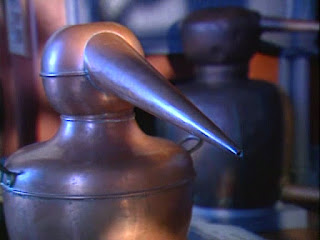
| A collection of pioneer stills at the Oscar Getz Museum of Whiskey History in Bardstown, Kentucky. |
Whiskey plays an outsize role in American history, largely because this continental nation had an active frontier for nearly 300 years and distilling was a typical pioneer industry.
Whiskey enthusiasts tend to focus on a narrower window, the middle to late 18th century, a period that saw the beginning of bourbon and the birth of a nation, when the frontier was the land west of the Appalachian Mountains and east of the Ohio and Mississippi Rivers.
On the frontier, whiskey-making was an adjunct to farming. Almost everyone grew grain and distilled some of it into liquor, one way or another. If you didn't have a still somebody in the neighborhood did. Distilling was the only sensible thing to do with surplus grain. Wherever fruit was plentiful, it was fermented and distilled too.
Distilled spirits were more than just another consumable. They were valuable. Where currency was scarce, as it typically was on the frontier, alcohol was a handy substitute. Fermented beverages such as beer, cider and wine were fine for drinking, but they were bulky and didn't keep. They weren't much good for high finance. Distill that beer down to about fifty percent alcohol-by-volume (100° proof), then you've got something.
Whiskey (or applejack) was like money in the bank. Everybody had a general idea how much a given quantity was worth, it was easy to divide, and always in demand. You could buy a nice farm with a barrel of whiskey. Abraham Lincoln's father did.
Businesspeople today talk about ‘liquidity.’ On the American frontier, ‘liquidity’ was literal. Alcohol was money. Before bourbon was bourbon it was a medium of exchange vital to the frontier economy.
On the frontier, most people were subsistence farmers. Communities were important but households had to be self-sufficient in food, clothing, and shelter. To live you needed a farm, and to farm you needed land. The constant need for more land inexorably pushed the frontier west. Since Roman times, governments have struggled to provide farmland for retired soldiers. The need for farmland following the French and Indian War (1754-1763) created friction between colonial administrations and the British government, leading to the American Revolution (1775-1783).
America’s original frontier had been the Atlantic coast, two fragile colonies of European immigrants in what would become Massachusetts and Virginia. Brewing and distilling began right away. Europeans brought with them barley, wheat, rye, oats and other Old World grains. The people who were already here introduced them to maize.
The word ‘corn’ originally referred to any grain. Wheat and rye were types of 'corn.' This usage lives on today in terms like 'barleycorn.' When Europeans encountered maize for the first time, they called it ‘Indian corn.’ Eventually, English speakers in North America shortened that to simply ‘corn’ and the word’s original, broader meaning died out.
Bourbon is whiskey made from maize, i.e., corn, a New World grain. That is what makes bourbon whiskey uniquely American. The first distilled beverages made in the colonies were not whiskey and the first whiskeys were not made from corn, at least not as the main ingredient. The first fermented beverages were made from fruit; mostly wild berries and grapes. Apples for cider were among the first cultivated fruit. When the first cereals the immigrants planted yielded their first harvests, food for animals and humans was the priority. Only when the fields yielded surpluses for those needs were cereals fermented and distilled.
As trade got going among the New World colonies, the residue of Caribbean sugar production was shipped to New England where it was distilled into rum for local sale and export. Rum was America's first commercial distilled spirit. In the mid-18th century, bad mojo with Mother England created a clog in the molasses pipeline just as the growing colonial population began to spread into the interior. Only then did Americans start to make whiskey…spirit distilled from a fermented mash of grain…in earnest.
At first they mostly used familiar cereals they brought from Europe: barley, wheat, rye, and oats, but by the 18th century they knew how to work with corn too.
If a frontier grain farmer had a surplus of anything it was corn. Corn grew well and was very productive. It was excellent livestock feed, which is how most of it was used, but had limited applications as human food, to European tastes at least. Unlike barley and wheat, corn contains no gluten so it isn't much good for bread. Pioneers tended to eat corn only when they had nothing else, which often enough was the case.
So they turned their surplus corn into alcohol. That wasn’t easy either, nothing on the frontier was easy. Despite obstacles, corn became the go-to grain for distillation in the lands west of the Appalachian Mountains.
To make alcohol, you need a solution of sugar, water, and yeast. Since yeast is almost everywhere, you often don’t need to do anything except mix the sugar and water together. With fruit or any other direct sugar source, such as honey or molasses, starting fermentation is easy. Left alone, a sugar-and-water solution will ferment whether you want it to or not.
It is harder with grain because you need an additional step. Cereals such as corn, barley, wheat and rye are mostly starch, so first you need to convert that starch into sugar. Seeds convert starch into sugar by producing certain enzymes. Any seed can produce the enzymes, but for our purposes the grain starches must be dissolved in water before the enzymes are introduced. Barley is favored because, when ground, its starches dissolve easily in warm water. Corn is tougher. To get its starches to dissolve takes hotter water, more time, and agitation.
Corn beer never caught on as a drink, but it was (and is) a terrific base for distillation. Corn the hogs don't eat can be converted into something useful.
The stage for bourbon was set.
| Curtiss P-40 Warhawk |
Eighty years ago today my father, Ken Cowdery, was at Schofield Barracks in Hawaii. He was a 21-year-old private in the United States Army, lined up for breakfast. Japanese bombers bound for Wheeler Field next door flew over his head, so close he could see the pilot's face.
Thirty years ago, for the 50th anniversary of Pearl Harbor, he wrote down some of his memories. Mostly they were stories we, his children, had been hearing for years. He passed in 2010, so it's nice to have them now in his own words.
The story of the morning attack I have posted on several of these anniversaries, most recently in 2018. This is what happened that evening.
In the immediate aftermath of the attack, chaos reigned on the island. Dad was company clerk, "like Radar on M.A.S.H.," he told us. His job that night was to monitor radio traffic, answer phones, and otherwise handle anything the officer in charge, Lt. Waid, needed him to do. Here is the rest of the story, in his own words.
___________________________
That night was scary, we could hear random bursts of small arms fire from time to time but had no inclination to investigate. The headquarters building was designated as a pick up spot for dependents to gather. The alert plan had this spelled out and busses were provided to haul them down to Honolulu to get them away from any legitimate target areas. While this mob of women and children was gathering downstairs a long burst of automatic weapon fire was heard nearby. The screaming did not subside for at least 10 minutes.
Fortunately, our people were pretty lousy shots at that point because we never heard of anyone being hit.
The worst case of trigger happiness occurred in our battalion. We had a 50 caliber machine gun set up on the roof of the barracks, it was on an anti-aircraft mount and protected by sandbags. Shortly after dark we heard a P-40 coming in low, (under certain wind conditions the normal landing path for Wheeler Field was directly over our barracks). As the plane approached the barracks we heard the 50 caliber open up. We didn't hear a crash so we figured everything was OK. A little while later we got a phone call, it was a Corporal from Wheeler Field asking us to inform the machine gunners that the plane they shot at was a P-40 and they should make sure what they're shooting at.
We had a field telephone line, not connected to the regular lines, over to the roof so we called them and told them to be more careful. They said that they were sorry, that it was an accident and it wouldn't happen again.
About a half hour later we again heard the familiar sound of a P-40 coming in on its landing path, and again we heard the POM, POM, POM of the 50 caliber. A few minutes later the phone rang again, this time it was a Sergeant, he was a bit more agitated and pointed out that we didn't have very many P-40s left and that our guys should quit trying to shoot them down. We called the gun crew again and chewed them out a bit, and they again said that they were sorry, that they were sure that it was a Jap and that they wouldn't do it again.
Sure enough, a bit later we again heard the familiar sound of a P-40 coming in and, unfortunately, the all too familiar sound of the 50 caliber. This time the call from Wheeler was very quick, very loud, (he wouldn't have had to use the telephone) and very angry. It was the pilot of the last plane. After several minutes of invective he said to tell those jerks up on the roof that he was informing all the other pilots still up in the air that if it happened again they should shoot back.
Lt. Waid and I went up to the roof ourselves and tried to impress these guys with the gravity of what they were doing and the probable consequences.
They seemed to be duly impressed and promised that it would never happen again. Lt. Waid and I got off the roof quickly and went back to headquarters, in time to hear yet another P-40 start its landing approach. You guessed it, again the 50 caliber opened up.
Then we heard the P-40 pilot pour on the coal. We could hear him circle around and approach the landing path again, only this time we heard his 50 calibers firing.
After that, no more phone calls, no more shooting at friendly planes--those guys probably never fired another shot for the rest of the war.
Lt. Waid and I went back up to the roof the next morning. There were several spots in the roof that we were convinced were 50 caliber bullet holes, none real close to the sandbags but close enough to scare the bejabers out of those gunners.
![]() |
| Guarding a Nike Hercules Missile, Fort Barry, CA; c. 1970-71 |
Nike was the Greek goddess of victory. Today it is a shoe company. Between those two uses, it was the name of an early missile defense system for the United States.
In the immediate aftermath of World War II, most Americans believed an attack by the Soviet Union was likely to come from high-flying Soviet aircraft armed with atomic weapons. By the time I came along (born in 1951) and became aware of such things, we worried more about intercontinental ballistic missiles (ICBMs). Rockets, not planes. This was especially true after the Cuban Missile Crisis (1962), which I remember vividly. I was eleven.
Designed in that earlier period, the Nike Missile Program was imagined as the last line of defense for American citizens, so the missiles were placed in and around major metropolitan centers.
My younger neighbors here in Chicago are surprised to learn that Montrose Point, a short and very pleasant walk from my apartment, used to house a Nike missile battery. At its peak there were 23 launch sites in the Chicago area. Two have been preserved for their historic significance, but not Montrose Point. It is now a bird sanctuary.
All of the Chicago sites were decommissioned long before I moved here. The only active Nike base I personally remember was just outside of Oxford, Ohio, where I lived from 1969 to 1974. I only became aware of it during campus antiwar demonstrations at Miami University when we heard that the National Guard had placed some troops there in case of trouble.
Subsequently, I drove out to see what I could see. Not much. I recall an imposing fence and gate and some kind of guard house and other structures. I couldn't see any missiles. The location of these installations was never a secret, although some were more public-facing than others. They wanted us to know about them because they were supposed to make us feel safe.
Around the country, some of the missiles were on military bases but most were on farms, in parks, and in residential neighborhoods. By 1953, the U.S. Army had begun building Nike air defense systems around 40 U.S. cities and military/industrial installations. At its peak ten years later, the Nike defense system included approximately 300 batteries in the United States. The nation's first operational, guided, surface-to-air missile, Nike was an important technological breakthrough in air defense. The Nike system brought together an array of antiaircraft, missile, computer, and radar elements. Nike could detect, identify as friend or foe, track, and destroy enemy aircraft.
Nike was just one part of continental air defenses during the Cold War. At the same time the U.S. Army was developing and deploying Nike, the U.S. Air Force produced its own surface-to-air missile systems. They were similar and a rivalry over them developed between the services. The U.S. Navy and the Canadian Air Force, as part of the North American Air Defense Command (NORAD), also shared the continental air defense mission.
Decommissioning of the Chicago-area batteries began in 1963. The end for the whole Nike system came in 1974.
![]() |
| 1869 Gaines, Berry & Company letterhead |
These series took on a life of their own as I was drawn into the orbit of James Crow’s pioneering work (Chronicle of James Crow) and to how Taylor faithfully followed Crow’s production procedures (Chronicles of Edmund Taylor Jr.). And Crow’s acolytes too, who spread the principles and adapted new learnings and ideas to advance whiskey with emergent technologies and biological processes, all practiced within the proximity of the city of Frankfort. Not manufacturing inferior bourbon whiskey of the 19th century, but topmost ‘hand-made, sour mash all-copper whiskey.’
The significance of the Crow-Taylor legacies in making America’s, probably the world’s best whiskey, remained hidden until the human and technical patterns revealed themselves as a cipher awaiting decoding. I have explained some of this plant, processes and ideas that evolved and adapted as technical knowledge advanced over the last half of the 19th century.
Manufacturing of this exceptional whiskey took place at only about a dozen distilleries in and around Glenn’s Creek-Frankfort area, with Crow and Taylor the common dominators.
The Oscar Pepper distillery was the epicenter, ground zero, due to Crow and later Taylor’s commitment to making whiskey of the highest sensory standards following the Crow principles. Outside of the modernized Buffalo Trace and Woodford Reserve distilleries, I cannot find another distillery approaching the deep history (Scotland, Ireland, Canada) that epitomizes the pedigree, provenance and pursuit of whiskey excellence these two distilleries displayed for more than 170 years. Both in their pre-Prohibition modes of manufacture and their late 20th-century commitment to manufacturing expressions of whiskey excellence.
My goal was to understand and decode the allegedly secret Crow’s methods and the developments in the manufacturing practices of Crow plan whiskey, centered in the Inner Blue Grass region. After years of analyzing thousands of primary records, it proved richer and more innovative than I expected to discover.
JAMES C. CROW: After an exhaustive record search of student’s attendance rolls at all the Scottish universities teaching medicine and science between 1726 to 1866 (Edinburgh, Glasgow, Marischal College, St Andrews, and Kings College Aberdeen), not one Crow was awarded a diploma or any graduation certificate at any of these universities.
Working with the Edinburgh University archivist, we deuced Crow may have attended ‘selected classes.’ In other words, he self-funded the particular lecturers and classes that he was keen to study, which did not entitle him to matriculate. At Edinburgh University at this time were some of the foremost scientists in fermentation and distillation. As a mature student, married with a child, and limited funds, this would have been a practical method to help advance his career prospects. Although why he abruptly left Scotland for Philadelphia in 1823 remains a mystery. Debts?
The first use of the salutation ‘Dr.’ James Crow appeared decades after his death in the local Woodford Weekly, then later picked up by the New York Times and St Louis Register, both publishing a story on Crow in September 1897. After Prohibition, the Old Crow whiskey trademark owned by National Distillers began propagated this term in their advertising campaigns after the Second World War. And like so many misattributions, the doctor moniker moved from error or misdirected praise, to marketing artifice, to become unquestioning fact.
EDMUND H. TAYLOR Jr.: Taylor joined Gaines, Berry & Company in April 1865. Previously, he ran a separate business as a commodity trader in cotton, corn and tobacco at Wolf Island, Missouri, after his finance ventures failed in Lexington and Versailles by 1860.
Twenty-seven old William Albertus Gaines returned to Frankfort in 1859, where he worked as a clerk for Walter Carr Chiles for two years, then appointed Frankfort’s postmaster in March 1861. He held this position for four years until the death of President Lincoln in April 1865. That month he founded Gaines, Berry & Company to become a local whiskey wholesaler. Before Gaines obtained his government position, there are indications he had discussions with Berry about the pair starting a whiskey business.
Hiram Berry held the majority of the shares in the new company, he previously traded livestock and cotton for the Union Army in Frankfort during the War years. At the same time, he established Gaines, Berry & Company, he also formed a trading pool for cotton with Samuel Pepper (Oscar’s brother), James Watson and Edmund Taylor Jr. However, the partners were unable to agree on terms, and the venture soon failed.
Taylor’s uncle and namesake, Edmund Haynes Taylor senior, was the cashier at the Frankfort branch of the Bank the Kentucky from 1835 until his death in 1872. He served the Bank’s State board of directors and two Frankfort branch presidents (Peter Dudley and Thomas Lindsay). Under Kentucky regulations owners were not permitted to hold executive roles in a bank. Before the antebellum period, the president of the Lexington branch of the Bank of Kentucky was Robert Todd, father-in-law to President Lincoln.
![]() |
| E. H. Taylor, Whiskey Mogul |
Something happened in a few places to upset that happy paradigm. Aging happened. Instead of a return on investment in a few days, it was going to take years. Years! How is that supposed to work?
In the United States, deliberately aging whiskey in new, charred oak barrels began about 200 years ago. We don't know exactly when but that's a conclusion based on what was being advertised at various times. Even after aged spirits became common, 'common' spirits (the unaged stuff) remained popular.
But as aged spirits became the norm, producers struggled to meet market demand. It wasn't easy to sell aged whiskey consistently for enough to finance its long maturation period. Aged whiskey had to compete with compound whiskey, a cheap knock-off that used artificial flavoring and coloring to imitate the flavor of wood-aged spirit. The market was chaotic and distillers easily became overextended. Unable to meet their obligations, many were forced to sell their businesses for whatever they could get. Often the new owner fared no better. Distilleries changing hands frequently.
Edmund Haynes Taylor (1830-1923) is a significant figure in American whiskey history for many reasons. He started or operated at least seven different distilleries, helped transform whiskey-making from an adjunct of farming into an industry, pioneered modern brand marketing, and was a leading advocate for federal government oversight of whiskey production and labeling.
He was also the mayor of Frankfort and an award-winning cattle breeder. Busy guy.
But his most enduring contributions to the industry may be in the matter of financing. Taylor began his business career in a bank owned by his uncle and namesake. While opening a branch in Versailles, he got to know distillers Oscar Pepper and Dr. James C. Crow. After Crow's death in 1856, some whiskey distilled by Crow was still in barrels and his former assistant knew how to make more, so Pepper and Taylor hatched a plan to capitalize on the reputation of Crow's barrel-aged whiskey. The Old Crow brand was born.
In 1860, Taylor and his bank organized Gaines, Berry and Co., Distillers, later reorganized as W. A. Gaines & Co., to make and sell Old Crow Whiskey.
Taylor's financing innovations, however, were not a perfect solution. Taylor himself became overextended to a customer named George Stagg and lost control of his largest distillery, today's Buffalo Trace.
After Prohibition was repealed in 1933, money was again a problem. Families like the Beams, successful whiskey-makers before the drought, had to look outside the family and beyond the Commonwealth for money. The Beams found it in Chicago, in investors Harry Blum, Harry Homel and Oliver Jacobson. Homel and Jacobson were investment bankers. They had an innovative idea of how to finance aging stock. Don't. Instead, sell it right away, like distillers did before aging, except sell it to your distributors. They'll buy the new make whiskey and pay you to age and eventually bottle it for them. Everyone expects the whiskey will become more valuable as it ages. This system spread out that risk. The distillery could put its capital into making more whiskey immediately.
The idea worked well for Beam. In a few years, Blum bought Homel and Jacobson out. They took their money, and their idea, down the road to Heaven Hill. It worked there too.
In the early days of craft distilling, many struggled with this same dilemma. Some still do.
Today, companies such as IJW Whiskey, CaskX and others are offering innovations of their own. Just like those Beam and Heaven Hill distributors, now you can place a bet on whiskey appreciation, not the sensory kind, the financial kind. This particular model is new and still unproven. Most of the whiskey in these schemes is from relatively new producers with no track record. Still, we saw just a few years ago what can happen to bulk whiskey prices when the market gets tight. With tariff relief, a new export boom could be right around the corner.
Or not. But that's the adventure, right?
![]() |
| Jimmy Raney, as I remember him. (Photo by Greg Turner) |
I lived in Louisville from 1978 until 1987 and have spent a lot of time there since, except these last two years. Even after I moved, until about 1994 I was in Kentucky almost as much as I was in Chicago.
I remember once, during some kind of festival, being up by the Brown Hotel in an outdoor plaza, watching and listening to an elderly man play electric guitar. He wasn’t busking, it was part of the festival, but very low key, casual. Louisville is a big city that sometimes manages a small-town feel. It was afternoon, sunny and warm. A nice day.
There wasn’t a stage, or a band, just the man, on a bench, with his guitar and amp. I joined the small crowd gathered around him. He was just playing. No chatting up the audience. No vocals. I don’t recall recognizing any melodies. It was jazz, freeform, mesmerizing. I happened upon him but stayed until he finished. His music left a mark.
I remember that instance clearly, but I know I saw him other times in other places too. I may have seen him with saxophonist Jamey Aebersold, the renowned jazz educator who is a familiar presence around Louisville. Louisville had a nice, little jazz scene then. A guy I knew from work played acoustic bass in a combo at the Seelbach Hotel's bar. I enjoyed the music but didn't think a lot about it.
At some point I learned that old guitarist’s name and looked him up.
It was Jimmy Raney.
His name probably doesn’t ring a bell unless you’re a big fan of 1950s American jazz. Raney was a ubiquitous sideman. He began his career in Chicago in 1944. Thereafter he played with Woody Herman, Artie Shaw, and many others. He is most remembered for his time in the 1950s with Red Norvo and Stan Getz. He won the DownBeat Magazine critics poll for guitar in 1954 and 1955. The New York Times called him "one of the most gifted and influential postwar jazz guitarists in the world".
They wrote that in his obituary. Jimmy Raney died in 1995. He was 67.
The obituary writer, Peter Watrous, also wrote this: “Mr. Raney's improvising, at its best, made clear that he had developed a lucid and distinct conception of both the swing and be-bop vocabularies. His lines often resolved on odd, pungent notes, and mid-solo his phrases rolled easily from his guitar as he constructed lengthy passages. His harmonic conception could be bleak and a touch bitter; he rarely relied on obvious or easy note choices. And he always varied his long lines with melodies and riffs.”
To the extent I understood any of that, it is how I remember the old man I saw playing in front of the Brown Hotel one sunny afternoon.
I learned that Raney was born and raised in Louisville. His father, a sportswriter for the Louisville Courier-Journal, died in 1944. Jimmy was 17. Traumatized by his father's death, he fled to Chicago where he had family and where there were more opportunities to play music for money than there were in Louisville. Once established, he relocated to New York, where he enjoyed his greatest success.
Raney left New York, and music, to return to Louisville in the late sixties, reportedly due to issues with alcohol. He resumed his career in the 70s and worked steadily thereafter, often with his son, Doug, who also played guitar and had a similar style, but he never again achieved the fame he knew in the 1950s.
Doug Raney is gone now too. He died in 2016 of heart failure. He was 59.
Jimmy had another son, Jon, an amateur pianist who works in IT. He maintains a website called “The Raney Legacy” at jonraney.com. He has an active blog. His extensive biography of his dad is here. I also recommend his post on the 94th anniversary of his father’s birth in August of this year.
One last thing. By the time I saw Raney, just a few years before his death, he was almost completely deaf from Ménière's disease. I can’t imagine how such a thing is possible, to play so beautifully even though you can’t hear what you’re playing. I didn’t know that when I heard him, only later.
Is there a takeaway from this? Not much of one, just reminiscing. But you never know about another person’s life and isn’t the internet marvelous for the curious?